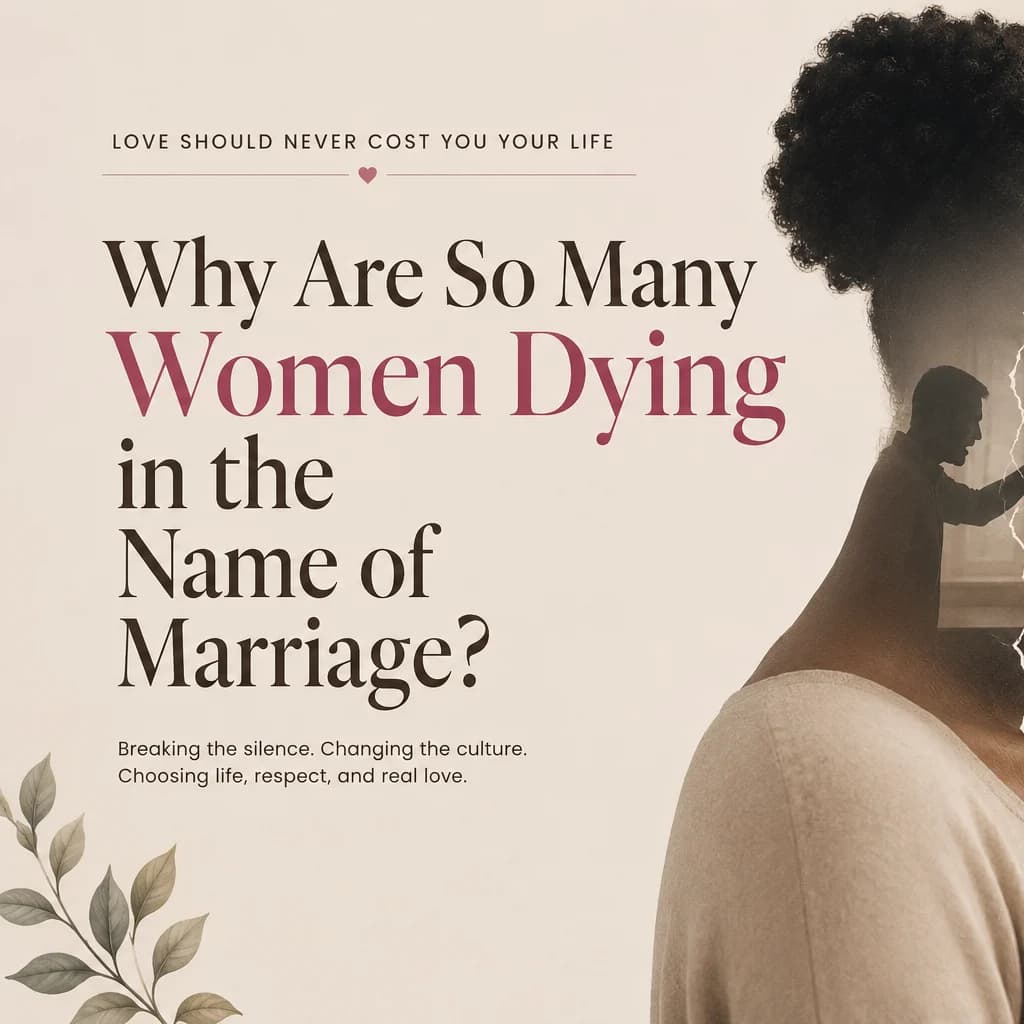
Every time another woman's face appears on our screens, bruised, lifeless, or reduced to a trending hashtag, we all ask the same question:
"How did it get this bad?"
And yet, a few weeks later, another story emerges.
Another woman beaten.
Another wife murdered.
Another mother whose children are left to grow up with nothing but memories and unanswered questions.
This isn't happening in one country alone. It is happening across continents, in cities and villages, in wealthy homes and struggling households. But in recent years, countries like Nigeria have witnessed an alarming number of heartbreaking cases that continue to spark outrage before quietly fading into silence.
The tragedy isn't only that women are dying.
The tragedy is that many of them were crying for help long before they did.
"I thought he would change."
"I stayed because of the children."
"My family told me every marriage has problems."
"I didn't want people to call me a failure."
These are sentences we've heard too many times.
Some women stay because they have nowhere else to go. Some stay because they are financially dependent. Others stay because they fear society more than they fear the man hurting them. Many are emotionally manipulated into believing the abuse is their fault or that enduring pain is simply the price of being a good wife.
Then there are those who try to leave.
Leaving, ironically, can become the most dangerous moment in an abusive relationship.
This is why asking, "Why didn't she leave?" is often the wrong question.
A better question is:
"Why did he believe he had the right to hurt her?"
No disagreement should end with broken bones.
No misunderstanding should end with a funeral.
No marriage vow includes permission for violence.
Some people still confuse control with love.
Jealousy becomes "protection."
Isolation becomes "care."
Threats become "discipline."
Slaps become "mistakes."
Before long, abuse becomes normal.
Until it becomes fatal.
We also have to confront a painful reality: too many people still encourage women to endure abuse in the name of preserving a marriage. Families urge patience. Friends advise silence. Religious and cultural expectations sometimes place the burden of "saving the home" almost entirely on the woman, even when her safety is at risk.
Marriage is sacred.
But so is life.
No woman should have to choose between keeping her vows and staying alive.
This conversation is not about teaching women to hate men. In fact, countless men are loving husbands, devoted fathers, and vocal advocates against violence. They deserve recognition too.
This conversation is about refusing to normalize abuse.
Real masculinity is not measured by intimidation.
It is measured by self-control, respect, responsibility, and protection—not fear.
The next time you hear someone say, "She's just going through a rough patch in her marriage," don't dismiss it so quickly.
Listen. Believe. Support.
Because behind closed doors, what looks like another argument to the outside world may actually be someone's final cry for help.
No relationship is worth a coffin.
No ring is worth a broken spirit.
And no woman should ever have to die proving she was committed to her marriage.