UI/UX for E-Commerce: Optimize Checkout for Nigerian Stores to Boost Sales
The Silent Killer of Online Sales: A Nigerian fashion vendor runs targeted Instagram ads, attracts 1,000 highly motivated visitors to their website, but records only five actual purchases. Where did the other 995 prospective buyers go? A deep dive into the analytics usually reveals a heartbreaking truth: they abandoned their carts at the final hurdle. The checkout user experience (UX) was too frustrating, slow, or confusing to navigate.
In the digital commerce landscape, traffic generation is only half the battle. The true determinant of profitability is conversion optimization. Mastering e-commerce checkout optimization has emerged as an elite high-income skill in Nigeria's evolving tech economy. If you possess the technical acumen to diagnose and repair a broken checkout flow, you transition from being a traditional UI/UX designer to a strategic growth partner who directly influences a company's bottom line. Brands are willing to pay premium consulting fees to specialists who can turn passive window shoppers into paying customers.
Section 1: The Unique Psychology of the Nigerian Online Shopper
Optimizing a digital storefront in Nigeria requires a profound understanding of local consumer psychology. Western design frameworks often fail when applied blindly to the Nigerian market because they do not account for specific cultural, economic, and infrastructural nuances.
The Trust Deficit and "What I Ordered vs. What I Got"
The foremost barrier to e-commerce growth in Nigeria is a pervasive lack of trust. Consumers are inherently skeptical due to years of widespread online scams and the infamous "What I ordered vs. What I got" phenomenon, where delivered items look nothing like their digital representations.
To overcome this psychological barrier, your user interface (UI) must explicitly communicate legitimacy at every touchpoint. This means embedding trust badges, secure SSL indicators, clear return policies, and real-time customer testimonials directly into the checkout flow. Seeing familiar safety signals reassures the shopper that their financial data is secure and that the merchant is verifiable.
Network Instability and Technical Performance
Nigeria’s digital infrastructure presents a unique challenge for web developers. Internet connectivity is frequently unstable, with many users browsing on erratic 3G or 4G mobile networks. A checkout page that takes longer than three seconds to load is a guaranteed sales killer.
Heavy, unoptimized graphics and bloated code cause pages to time out, inducing anxiety in the user who may fear being debited twice. Maximizing conversion rates requires an aggressive focus on performance optimization: compressing image assets, leveraging browser caching, minimizing JavaScript, and ensuring the layout remains lightweight.
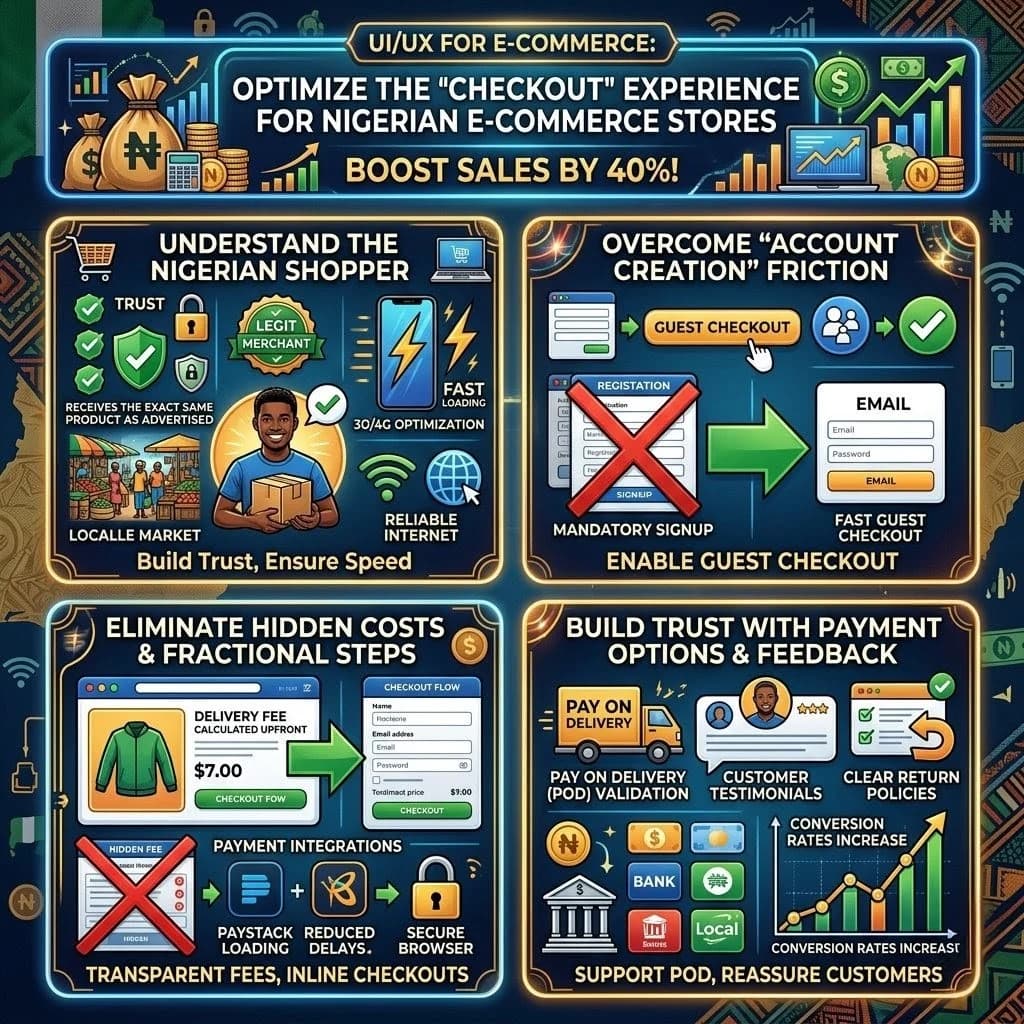
Section 2: 4 Fatal Checkout Flaws (And How to Fix Them)
A seamless checkout process should feel like a downward slope effortless and fast. Unfortunately, many Nigerian e-commerce platforms inadvertently build digital brick walls that turn customers away at the exact moment they intend to pay.
Flaw 1: Forcing Account Creation
Nothing halts purchasing momentum faster than forcing a user to register an account before they can buy an item. Demanding that a customer create a password, confirm their email, and fill out an extensive profile introduces immense friction.
The Fix: Enable a frictionless Guest Checkout option. Allow users to complete their purchase using only an email address or a phone number for order tracking. You can always invite them to create an account on the "Thank You" confirmation page after you have already secured their money.
Flaw 2: Hidden Delivery Fees
Transparency is paramount in building digital rapport. A common, conversion-killing mistake is hiding shipping and logistics fees until the absolute final step of the transaction. Discovering an unexpected fee right before clicking "Pay Now" triggers immediate buyer's remorse and cart abandonment.
The Fix: Display clear delivery estimates and baseline shipping costs upfront on the product page or via a dynamic shipping calculator in the shopping cart. When consumers know the total cost early in their journey, they are far more likely to finalize the transaction.
Flaw 3: Confusing Payment Portals
Payment friction is a massive leak in the e-commerce funnel. If a customer clicks "Pay," and is redirected to an external, slow-loading gateway page that hangs mid-transaction, they will abandon the purchase out of fear of financial errors.
The Fix: Integrate inline checkouts using modern payment gateways like Paystack or Flutterwave. These systems keep the user natively on your website through pop-up modals or embedded fields, reducing technical steps and maintaining a cohesive visual brand experience that keeps trust intact.
Flaw 4: Lack of "Pay on Delivery" Options
Despite the growth of digital banking, a segment of the Nigerian populace still prefers cash or point-of-sale (POS) terminal payments upon arrival due to trust and verification issues. Platforms that completely omit a "Pay on Delivery" (POD) option automatically alienate a substantial percentage of potential buyers.
The Fix: For brands with the logistical capacity to support it, include a conditional POD option. To mitigate the business risk of fake orders, you can use UI micro-copy to explain that POD is available for validated addresses or specific geographical zones, striking a balance between customer convenience and merchant safety.
Section 3: Setting Up a UI/UX Audit Business
The demand for e-commerce optimization creates a lucrative opportunity for enterprising digital creators, low-code developers, and product marketing managers to launch a specialized UX auditing service. You do not need to be a master coder to start auditing; you simply need to understand user behavior analytics.
Leveraging Free Behavioral Analytics Tools
You can utilize powerful, free user-behavior tools such as Hotjar or Microsoft Clarity to uncover hidden flaws on a merchant's website. By securing permission from a business owner to install a lightweight tracking script, you can view real-time session recordings and heatmaps of actual users navigating their digital storefront.
These tools show you exactly where users hover, where they repeatedly click out of frustration (rage clicking), and the precise field where they abandon the form. This empirical, data-driven approach removes all guesswork from the optimization process.
Securing Premium Redesign Contracts
Once you gather this behavioral data, the next step is transforming it into a compelling business proposition. Instead of telling a business owner that their website "looks bad," present them with a highly visual slide deck that outlines your findings.
Show them video clips of users struggling to check out on mobile devices, point out the exact friction points, and calculate the potential revenue they are losing every single month based on their current traffic. Presenting clear evidence alongside a tailored design solution makes it incredibly easy to secure premium, high-ticket UI/UX redesign contracts. Merchants will happily invest in your services when they realize that your work pays for itself by reclaiming lost revenue.
Navigating the 2026 Nigerian Digital Economy
As the landscape evolves, mastering high income skills in Nigeria 2026 is becoming the definitive pathway to securing high-paying remote jobs from Nigeria. As local and international businesses compete for online market share, the demand for specialists who understand the intersection of human psychology and digital design is at an all-time high.
Whether you want to learn UI/UX design from scratch, transition into a high-paying product marketing manager salary bracket, or establish yourself as a specialized FlutterFlow developer capable of building lightning-fast e-commerce apps, optimizing the checkout experience is a foundational skill.
By mastering these e-commerce optimization tips, you position yourself as an invaluable asset in the digital marketplace turning broken web pages into high-converting, revenue-generating engines.