How to Launch a ₦500k+ Low-Code App Business for Local SMEs
The high cost of custom software development has long created a digital divide for small and medium-sized enterprises (SMEs) across Nigeria. While massive corporations deploy bespoke enterprise resource planning (ERP) systems to streamline their operations, local businesses ranging from bustling interstate logistics firms in Ojota to multi-branch supermarkets in Abuja and private schools in Port Harcourt are routinely left behind. These businesses desperately need tailored digital tools to track inventory, manage staff payroll, and monitor daily deliveries. However, when traditional software development agencies quote starting prices of ₦5,000,000 to ₦10,000,000 for a custom build, the conversation immediately ends.
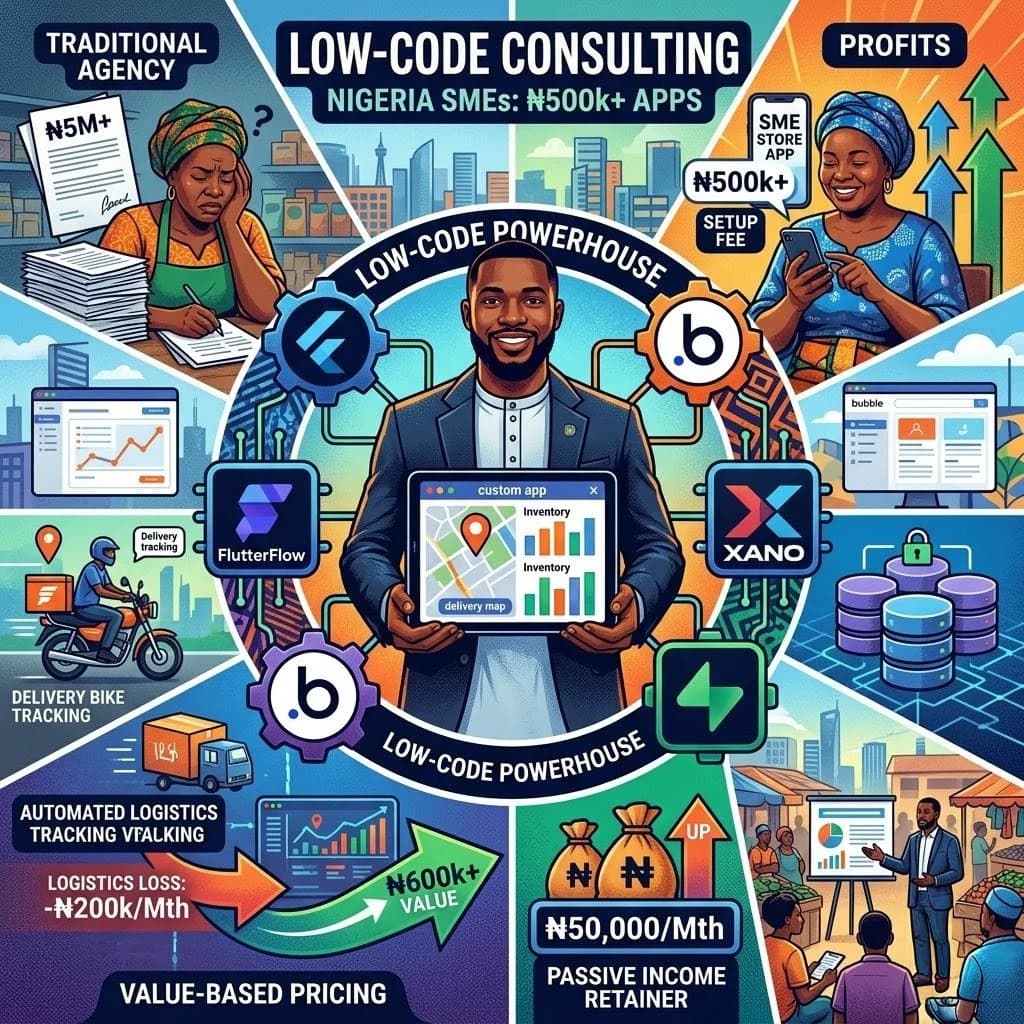
This financial barrier has created a massive, unserved market gap. The solution that is currently reshaping the local tech ecosystem is low-code and no-code consulting. By leveraging advanced visual development platforms, independent consultants and agile agencies can now build professional, highly secure, and deeply customized enterprise applications in a fraction of the traditional timeline. What used to take a team of full-stack developers six months to code from scratch can now be deployed by a single low-code consultant in three to four weeks. This drastic reduction in production time allows consultants to offer highly competitive local rates charging upwards of ₦500,000 per project while retaining nearly 90% of the contract value as pure profit.
The Modern Low-Code Tech Stack
Succeeding as a high-value consultant requires moving beyond basic website builders and mastering the powerful visual development platforms that dominate the industry. These tools offer the pixel-perfect design control and complex logic capabilities required by modern businesses.
FlutterFlow for Native Mobile Applications
When a local client requires a mobile-first solution such as a real-time delivery tracking app for a dispatch company or a dedicated ordering app for a neighborhood grocery chain FlutterFlow is the premier choice. Built on top of Google’s Flutter framework, it allows consultants to visually design stunning UI/UX interfaces while automatically generating clean, production-ready Dart code under the hood. The primary advantage of FlutterFlow is its cross-platform efficiency; you can deploy a single codebase to both iOS and Android app stores simultaneously, drastically cutting down deployment timelines.
Bubble.io for Complex Web Applications
For internal business dashboards, multi-vendor marketplaces, and complex data-heavy systems, Bubble remains the absolute industry standard. Bubble’s visual workflow builder allows you to map out intricate business logic such as triggering automated email receipts, calculating variable vendor commissions, or generating monthly financial reports without writing a single line of JavaScript. It is the ideal engine for building robust, browser-based software that can handle hundreds of concurrent staff users.
Supabase and Xano for Scalable Backends
While platforms like Bubble have built-in databases, scaling a business app often requires a dedicated backend-as-a-service (BaaS). Tools like Supabase (an open-source Firebase alternative utilizing PostgreSQL) or Xano provide secure, scalable data storage. They allow you to establish complex relational databases, manage user authentication, and process heavy server-side workflows visually. Utilizing a separate backend ensures that if a client's operations expand from one warehouse to ten, the application’s infrastructure can handle the increased data load seamlessly.
Value-Based Pricing and the Retainer Model
The biggest mistake a modern low-code consultant can make is pricing their services by the hour or trying to compete with cheap freelancers on gig platforms. Local business owners do not care how many hours you sit in front of a laptop; they care about the tangible business problems you solve.
Transitioning to Value-Based Pricing
To charge ₦500,000 or more per project, you must align your pricing with the financial impact of your solution. Consider a mid-sized logistics company losing approximately ₦200,000 every month due to unrecorded waybills, fuel theft, and disorganized dispatch tracking. If you propose a custom low-code mobile app that digitizes the entire supply chain and completely eliminates that ₦200,000 monthly leak, you are saving the business owner ₦2.4 million annually. In this context, charging a one-time setup and development fee of ₦600,000 or ₦800,000 is not an expense it is a high-return investment that pays for itself within a few months.
Building Predictable Recurring Revenue
The true financial sustainability of a low-code consulting practice lies in the recurring retainer model. You should never hand over an application and walk away. Instead, bundle the ongoing hosting costs, database management, minor bug fixes, and monthly security updates into a compulsory "Maintenance and Hosting Fee" of ₦50,000 to ₦80,000 per month, depending on the complexity of the system.
By securing just five active clients on a ₦50,000 monthly retainer, you establish a predictable, recurring baseline income of ₦250,000 per month. This passive stream covers your software subscription overhead and provides financial stability while you source your next major development contract.
Strategic Client Acquisition in the Local Market
Landing your first high-paying client in Nigeria requires shifting your approach away from highly technical jargon. Local business owners are frequently alienated by terms like "API integrations," "relational databases," or "cross-platform frameworks." To close deals, you must pitch solutions, not technology.
The Foot-in-the-Door Strategy
The most effective way to secure a meeting with a business owner is to identify their operational pain points firsthand. Walk into a target business whether it is a local pharmacy, a private school administration office, or a microfinance branch and observe their daily operations. Identify the most chaotic, paper-dependent, or spreadsheet-heavy process they currently run.
Initiate the conversation by asking the manager or owner a straightforward question: "What is the most tedious, time-consuming manual process holding your team back right now?"
Once they explain the headache such as manually cross-referencing paper inventory logs at the end of every business day you present the solution. Offer to automate the entire process into a secure digital dashboard accessible from their smartphone. You can even offer to build a basic, clickable prototype of their specific dashboard using placeholder data within 48 hours.
When a business owner sees a working visual representation of their own business operations simplified on a screen, the sale transforms from a cold pitch into an easy negotiation.