The Hidden Emergency System at Work
Imagine stepping outside on a cold morning.
At first you may not notice the chill.
Then your shoulders begin to tense up.
Your muscles begin to quiver.
Your teeth chatter.
And all of a sudden, your entire body begins to shake uncontrollably
Why is that?
Because your body is trying to maintain your body temperature.
🌡️ YOUR BODY IS ALWAYS SENSING THE TEMPERATURE
Your body has an optimal temperature range.
Your nervous system is constantly relaying information to you concerning your internal and external environments.
When your body realises that you are too cold, the body can perform a variety of actions to try and combat the cold.
One of those actions is shivering.
🧠 THE BRAIN SENSES AND ACTS
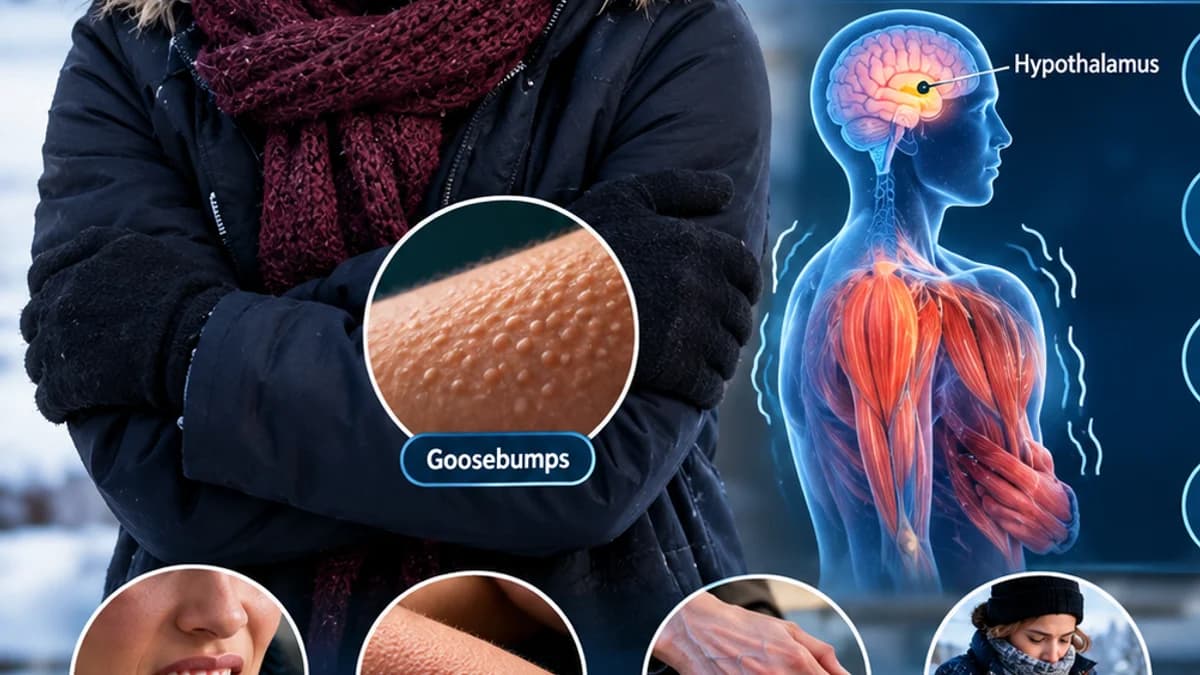
One specific area within your brain, the hypothalamus, is responsible for many vital functions, one of these is the regulation of your core body temperature.
This means that when your body begins to get too cold, your hypothalamus acts in order to either create or conserve heat within your body.
You don't have to tell your body to start shivering.
It just does it, automatically.
💪 WHY DO YOUR MUSCLES BEGIN TO TREMBLE?
Shivering is the result of your skeletal muscles twitching, involuntarily.
The body requires energy in order for your muscles to contract.
Some of that energy gets converted into heat, the byproduct of which is that you begin to feel warmer.
So really, there is an important reason as to why you begin to shake when it's cold:
TO CREATE HEAT.
Your muscles are essentially becoming a heating device.
🔥 WHY CAN SHIVERING MAKE YOU FEEL WARM?
Think about it.
You constantly contract and relax your muscles while you're shivering.
That means that you are generating more heat than you would at rest.
Therefore, you are able to resist the cold to a certain extent.
However, shivering is not an infinite source of heat.
So, if you expose yourself to cold temperatures for long enough, then eventually your core body temperature will drop.
That's because the rate at which your body is losing heat exceeds the rate at which you are gaining heat.
🩸 YOUR BODY CONSERVES HEAT IN OTHER WAYS
Shivering is not the only way that your body combats the cold.
Shivering is only one tool in your body's armoury to deal with the cold.
By constricting some of the blood vessels near your skin, your body can prevent too much of your blood from flowing to your extremities.
Therefore conserving heat and preventing your core body temperature from dropping too drastically.
That's why your hands and feet can get so cold in the winter.
Your body is sacrificing the warmth of your hands and feet in order to ensure that your core organs remain warm.
🐔 AND WHAT ABOUT GOOSEBUMPS?
As well as making your muscles twitch, the cold can also make the small muscles attached to your hairs stand on end. This causes the characteristic "goosebumps" that we all get on our skin.
Now, in furry animals, this is useful because it stands their fur up, trapping a layer of warm air against their skin.
However, humans don't have much fur anymore, so this reaction doesn't really serve a useful function anymore.
🦷 WHY DO YOUR TEETH CHATTER?
Teeth chattering is essentially another form of shivering, except it is performed by the muscles around your jaw, rather than your skeletal muscles.
This is what causes that characteristic "chattering" sound that we hear when the cold is getting to someone.
It is strange to think that your nerves can make you do things like this without you even realising it.
❄️ THE LIMITATIONS OF SHIVERING
Shivering can be an effective way of generating heat for short periods of time.
But if you expose yourself to the cold for too long, then your body can no longer generate heat as quickly as it loses it.
Therefore, you begin to suffer the effects of exposure to the cold.
That's why severe cold exposure shouldn't be taken lightly
🧠 YOUR BODY DOES ALL THIS WITHOUT A CARE
The really cool thing about this whole system is that you don't have to think about any of it. Your nerves and muscles are doing all this work without you having to tell them to.
While you're just standing there, shivering, your entire nervous system is working overtime to try and keep you warm.
🌍 THE BIGGER PICTURE STILL REMAINS
Shivering is an interesting reminder of just how amazing our bodies are.
Our body constantly adjusts itself in response to its environment in an attempt to achieve optimal conditions for itself.
Although it can be annoying when we're outside and start shaking, it's actually an incredibly complex system that is required to keep us warm.
🌿 AN ETHICAL REFLECTION
Life is so much more interesting when you look at it from this perspective.
We so often take our incredible bodies for granted. We don't notice the complex processes going on inside of us unless we notice something going wrong.
But a little observation can go a long way.
Maybe some people could look at the world differently by noticing these interesting little quirks our bodies have.
Perhaps a bit of biological analysis could be a fun way to learn about the world around us.
❓ QUICK QUESTIONS
Why do we shiver?
Shivering is the result of rapid, involuntary muscle contractions that produce heat
Which part of the brain helps regulate our body temperature?
The hypothalamus is an area in your brain that plays a key role in regulating your body temperature.
Does shivering actually produce heat?
Yes, shivering generates heat by causing rapid contractions of your skeletal muscles.
Why do hands and feet become cold?
Your blood vessels have the ability to constrict, in order to reduce the amount of heat that is lost through your arms and legs, in order to preserve your core body heat.
Why do we get goosebumps?
Tiny muscles on your skin can contract in response to the cold, in order to stand your hairs on end.
This traps a layer of warm air against your skin, however, it is somewhat ineffective in humans, due to the lack of body hair we possess.
📌 KEY TAKEAWAYS
• Shivering is an involuntary response to cold
• The hypothalamus helps to regulate our body temperature
• Rapid muscle contractions produce metabolic heat
• Blood vessel constriction can help conserve heat
• Goosebumps are another response to the cold
• Shivering can't keep you warm forever
• Much of the regulation of our body temperature is automatic
CONCLUSION
Next time you find yourself shivering on a cold morning, appreciate the fact that your body is doing everything it can to keep you warm
Your nervous system senses the cold and acts upon it by initiating a number of physiological responses.
Your muscles generate metabolic heat, your blood vessels constrict to try and preserve your core body heat, and so on and so forth.
That unexpected shivering sensation is actually a pretty awesome way of trying to keep you warm.
🥶 QUESTION
What other everyday reaction of the human body have you experienced but never stopped to ask, "Why does this happen?"
SOURCE
National Institute on Aging (NIH) - information on body temperature regulation and cold exposure.
More @