The Optical Illusion That Makes the Moon Appear to Travel Alongside You
You're sitting in a car at night.
Trees whip past.
Buildings appear and then disappear.
But when you glance up at the sky, the Moon is still there.
You travel a few streets.
You glance up.
It appears to have followed you.
You turn another corner.
There it is again.
Is the Moon actually following you?
No.
But the reason why might surprise you.
It has to do with perspective, distance and the way your brain interprets what it sees.
🌙 THE MOON IS EXTREMELY FAR AWAY
The first reason has to do with the distance between the Moon and the Earth.
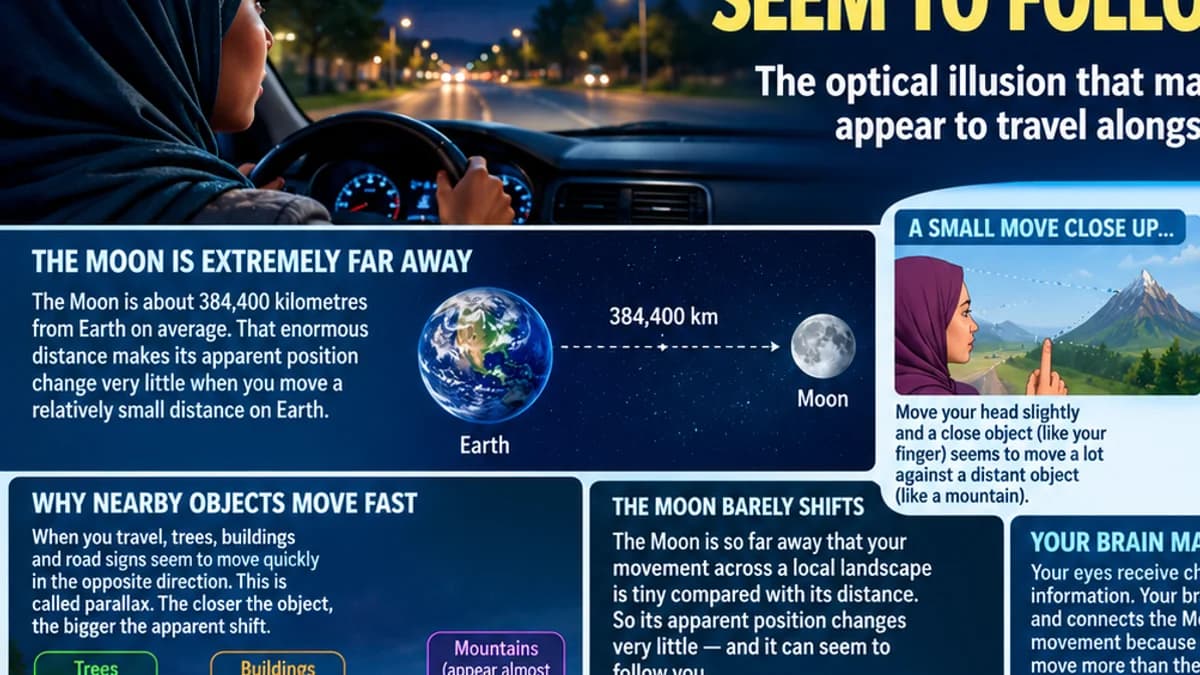
The Moon is about 384,400 kilometres away on average.
This great distance plays a large role in how its apparent position changes when you move a small distance on the surface of the Earth.
If you hold your finger close to your face and you look at a distant mountain, then you move your head from side to side, your finger will appear to jump back and forth.
The mountain, on the other hand, will hardly seem to move at all.
The same principle applies in this case.
🚗 WHY DO TREES SEEM TO MOVE SO FAST?
If you look out of a car window while on the move, you can probably see a tree on the side of the road.
If the tree is close to the car, it appears to move backwards very quickly as you pass it.
A road sign will seem to fly past, whereas a distant building will only appear to move slowly.
Very distant mountains might hardly move at all.
This is called a PARALLAX.
A parallax is the apparent change in the position of an object due to a change in the position of the observer.
In other words, the closer something is, the more it will appear to move, if you move your point of reference.
The more distant something is, the less it will appear to move.
🌌 THE MOON BARELY SHIFTS FROM YOUR POINT OF VIEW
When you look at the Moon, you will have to move many metres or even kilometres before you notice a significant change in its apparent position in the sky.
That's a long way to go, but compared to the distance to the Moon, your movement is miniscule.
The apparent change in position of the Moon is, therefore, much smaller than the apparent change in position of closer objects.
Your brain notices this difference.
It thinks that the trees and buildings are moving, but the Moon is staying in the same place.
It interprets this information to conclude that the Moon is following you.
🧠 YOUR BRAIN IS TRYING TO MAKE SENSE OF MOTION
Your eyes are constantly receiving changing visual information.
Your brain uses this information to determine the position of objects, as well as their motion.
When the trees and buildings are moving, but the Moon is staying in the same place, the brain will try to make sense of this information.
It will try to determine what's happening.
As a result, the Moon appears to be a companion that travels with you, when in fact, it's just very far away and therefore doesn't seem to move.
👆 TRY A SIMPLE EXPERIMENT
Hold a finger close to your face, and look at something in the distance.
Then move your head from side to side.
Your finger will appear to jump from side to side.
The object in the distance will only appear to move very little.
Now imagine stretching the distance to that object in the distance by a huge amount.
Now the apparent movement of that object will be even smaller still.
This is the basic mechanism behind why the Moon appears to follow you.
✈️ IT CAN HAPPEN FROM OTHER MOVING PLACES TOO
You don't necessarily have to be walking on the street for this to happen.
The same phenomenon can be seen from a car, bus, train or aeroplane.
A distant mountain, star or the Moon itself may appear to stay with you, while closer objects move past you more quickly.
The more the objects around you move, the more contrast there is with the apparent movement (or lack thereof) of a distant object.
🌍 IS THE MOON ACTUALLY MOVING?
Yes, but not because of you.
The Moon is constantly moving through space.
It orbits the Earth, and the Earth rotates around its axis, which in turn orbits the Sun.
The combination of these movements causes the Moon to change its position in the sky.
The important factor is that the small amount that you move on a road trip or similar journey is not enough to cause a significant change to the apparent position of the Moon.
It's just too far away.
👀 WHAT YOU SEE IS REAL—BUT YOUR INTERPRETATION MATTERS
The Moon really does appear to stay with you.
The fact is completely real.
The surprising part is the explanation.
What's happening is that your eyes are receiving real visual information, but your brain has to interpret this information in order to understand it.
This process is important.
Sometimes, our experience of something is right, but our interpretation of it is wrong.
That's an important part of science.
Science begins when a person looks at a phenomenon and asks themselves this question:
" Why does this happen? "
Instead of accepting what they see at face value and stopping there, they investigate to find out the mechanism that causes it.
❓ QUICK QUESTIONS
Is the Moon actually following you?
No. Its apparent "following" is mainly a perspective effect, caused by its enormous distance compared to the small distance you travel.
What is parallax?
Parallax is the apparent change in an object's position, when viewed from different locations.
Why do nearby objects move more noticeably?
Changing your position creates a larger apparent shift for nearby objects than for extremely distant objects.
Does the Moon actually move?
Yes. The Moon orbits the Earth, while the Earth rotates and moves through space.
Can you experience the same effect with stars?
Yes. Extremely distant objects can appear to be nearly fixed, while nearby objects change position dramatically as you move.
📌 KEY TAKEAWAYS
• The Moon is not following individual people or vehicles.
• Its enormous distance causes its apparent position in the sky to hardly change during ordinary travel.
• Nearby objects appear to have a much greater change in position.
• Parallax can explain this phenomenon.
• The brain uses visual information it receives from the eyes to interpret motion and distance.
• A real visual experience can sometimes have a surprising explanation.
CONCLUSION
The next time you travel at night and notice the Moon seemingly keeping pace with you, take a look around.
The trees are rushing past.
Buildings are changing position.
Road signs disappear behind you.
But the Moon seems to remain almost perfectly in place.
It isn't following you.
It just happens to be very, very far away.
And that's a very good lesson in perspective.
🌙 QUESTION TO THINK ABOUT
What other things have you noticed in everyday life that seemed strange until you discovered the science behind them?
SOURCE
NASA — Solar System Exploration: The Moon.