
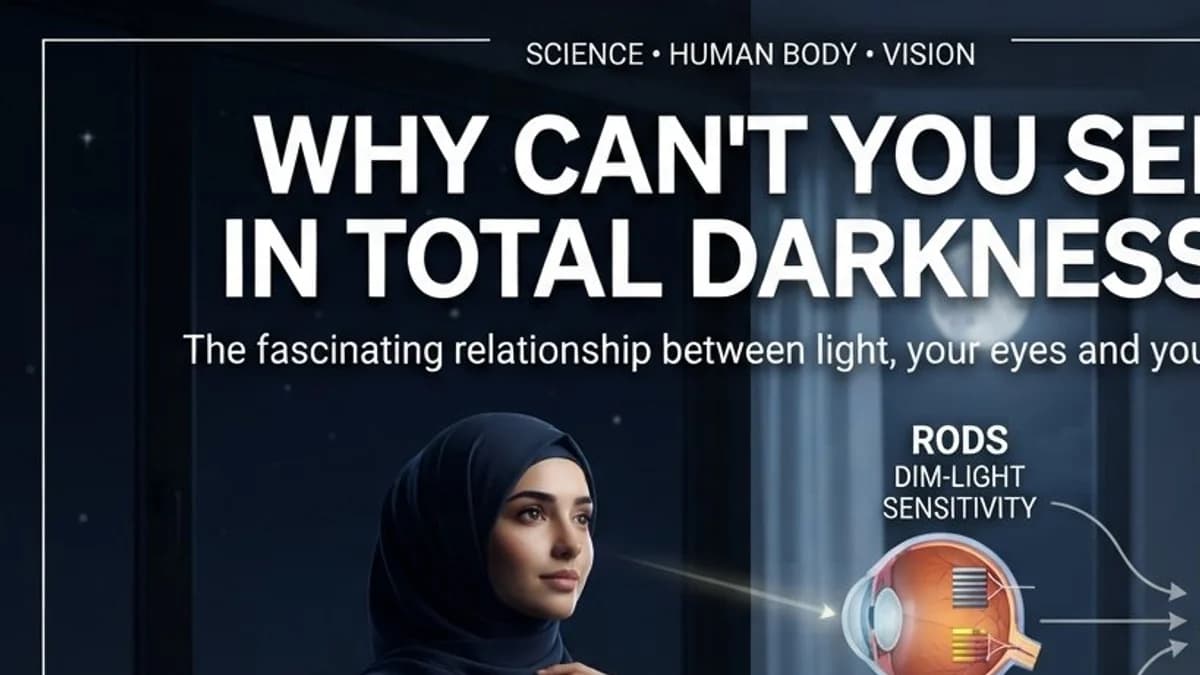
The Surprising Relationship Between Light, Eyes and Brain
Imagine you walked into a pitch-black room
At first, you could not see anything at all
Soon, you might begin to see shapes
It's as if you eyes just "turned on"
But how does this really work?
Your eyes are adapting to the darkness, but why is that?
💡 WITHOUT LIGHT, VISION HAS ABSOLUTELY NOTHING TO WORK WITH
Vision begins when light falls upon the retina, a light-sensitive tissue at the back of the eye
Photoreceptor cells absorb this light and convert it into neural signals for the brain to interpret. Since there is no light in total darkness, there can be no vision. It's not simply a case of being in a dimly-lit room versus a dark one.
🌙 YOUR EYES DON'T SIMPLY "WAIT"
There are different types of photoreceptors in the retina. The main ones are RODS and CONES.citeturn0search0
RODS are more sensitive to light, and are used in dim conditions
CONES are less sensitive to light, but are used in bright conditions and allow for color vision
When you go from light to dark conditions, your eyes slowly become more sensitive to the small amounts of light available to see things. Your visual system is "dark-adapting"
🔦 THAT'S WHY IT TAKES TIME TO ADAPT TO DARKNESS
Say you left a bright room and looked outside at night
When you first looked outside, it was still totally dark for a few seconds
Your eyes just came from a very lit environment, and needed time to get adjusted.
Adaptation is the process of getting used to the amount of light present
As adaptation occurs, you can see things that were previously not visible to you
Scientists at the National Eye Institute (NIH) have studied the molecular mechanisms of adaptation in rod photoreceptor cells, a type of light-sensing cell.citeturn0search4
👁️ WHY DO THINGS LOOK DIFFERENT AT NIGHT?
Try this at home: look at the sky from a brightly-lit city. Now, try looking at the sky from a remote area with no light pollution.
You might notice that there are significantly more stars visible to the naked eye in the absence of artificial light sources.citeturn0search8
Bright city lights make the sky "glow" with light, masking dimmer stars. In the absence of this, your eyes can adapt to lower levels of light, see more stars, and there is also an overall reduced background level of light compared to when you were in the city. It's not that your eyes are generating more stars, but that they can see more of them.
YOUR BRAIN FINISHES THE JOB
The retina forms neural signals to send to the brain, citeturn0search2 which then interprets them. What your brain does is vital to vision. When you first walk into a totally black room, your brain receives no visual information.
Once you get used to the dark, it receives more. Seeing isn't just your eyes, it's your brain too. So the next time you walk into a dark room and see more and more, you know it's your eyes and brain.
🌑 BUT WHAT IF THERE IS NO LIGHT WHATSOEVER?
The fact is, if there is absolutely no available light reaching the eye, dark adapatation will not help you see the object. Your eyes might be able to see with a miniscule amount of light, but they still need some. Dark adaptation may give you more sensitivity, but it can't make objects appear if they are not there.
🌿 AN ETHICAL REFLECTION
This makes a powerful statement about science and society
Sometimes, the information we get isn't always what is out there, but what we are able to get out of it. A good analogy would be that sometimes you can't see an animal in the forest because of the conditions - but that doesn't mean it isn't there. A dark room may seem empty, but there are still things you can learn about it.
❓ QUICK QUESTIONS
Why can't you see in complete darkness?
Because you need light for vision
What are rods?
Rods are light-sensing receptors in the retina that are used in dim conditions. citeturn0search0
What are cones?
Cones are light-sensing receptors in the retina that are used in bright conditions and allow for color vision. citeturn0search6
Why does it take time to adjust to darkness?
It takes time for your eyes to adapt to new conditions
Can your eyes see with absolutely zero light?
No.
KEY TAKEAWAYS
• Vision requires light
• The retina has light-sensitive cells called photoreceptors
• Rods are important for vision in dim conditions
• Cones are important for vision in bright conditions
• Dark adaptation increases sensitivity after coming from a bright place
• Total darkness allows for no light-sensitive cells to work
• Your brain is essential for vision
CONCLUSION
Now, the next time you walk into a dark room and slowly see things, you'll know why. Your eyes are working overtime to sense the tiniest amounts light and send the signals to your brain. Darkness might appear "empty", but your visual system is working hard to find the information hiding within it.
🌙 FEEDCOVER QUESTION
Have you ever noticed that it seems like you can see more after spending several minutes in darkness?
SOURCE
National Eye Institute (NIH) - Studying rods, cones and dark adaptation. More @https://bilkisu-hub.blogspot.com