Nigeria’s power conversation is often national: megawatts, grid reforms, transmission upgrades. Builders don’t wait for national fixes. They go where money already changes hands and build power where power is demanded daily.
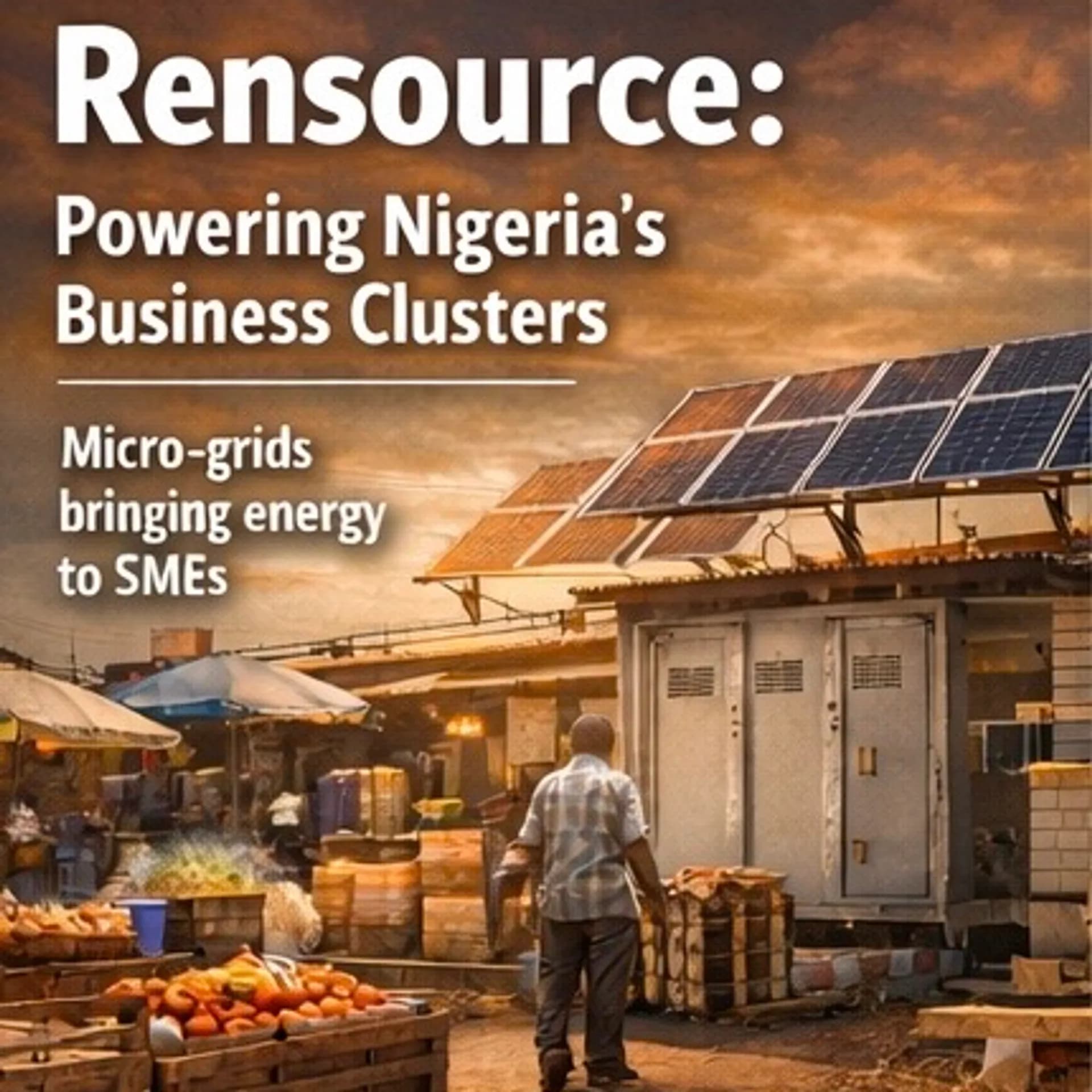
Rensource is positioned as a provider of energy and merchant services to SMEs, with a model that focuses on micro-utilities for commercial clusters. Ademola Adesina is founder/CEO, and the company has described itself as building clean-energy based micro-utilities for SME clusters. 
The unseen builder story here is not “renewables are good.” It’s that Rensource treats electricity as an enterprise service — sold in places where businesses can pay because power directly converts to revenue.
The key insight: clusters are the real customer
Selling energy to scattered households is difficult: low consumption, high churn, high collection cost. Selling energy to clusters is different:
• demand is concentrated,
• ability to pay is higher,
• revenue impact is immediate,
• distribution is contained.
Markets, industrial clusters, and dense SME streets are natural “energy nodes.” If you can power a node reliably, you create a captive economy around your system. And unlike the grid, your promise is not “someday.” It’s “today.”
Why reliability beats cheapness
In Nigeria, businesses often run generators not because it’s cheap, but because it’s predictable. Predictability is a product. If your system delivers reliable power at a competitive cost, you win not just by saving money, but by reducing operational stress:
• fewer generator breakdowns,
• less fuel logistics,
• less noise,
• less downtime.
Builders in this category sell peace of mind.
Energy + payments is the underrated combo
Rensource has spoken about combining energy provision with merchant/payment services.  That combination matters because it turns a utility into a commerce platform:
• you can meter usage,
• you can create recurring billing,
• you can bundle other SME financial services,
• you can capture transaction flow in the cluster.
This is how “infrastructure businesses” quietly expand: start with the essential constraint (power), then layer monetization on top (payments, services, financing).
The African builder’s strategic move: build where enforcement is natural
A huge issue in utilities is enforcement and collections. In clusters, enforcement is simpler because:
• the service is localized,
• disconnections are visible,
• social pressure is real,
• customers are businesses that need continuity.
You’re not fighting millions of individual disputes. You’re managing a contained ecosystem.