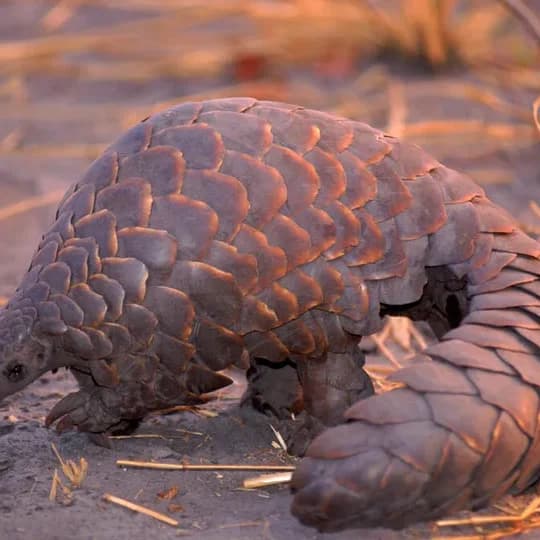
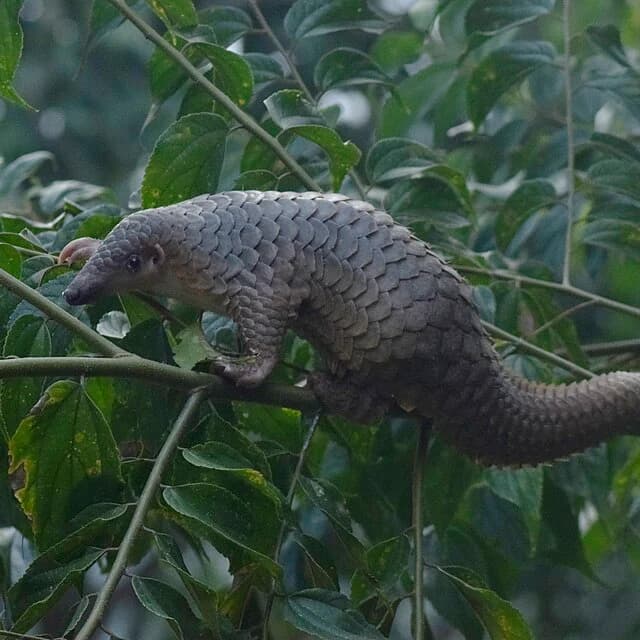
Pangolins, also called scaly anteaters, they are mammals of the order Pholidota. Though many think of them as reptiles, pangolins are actually mammals.
The one extant family, the Manidae, has three genera: Manis, Phataginus, and Smutsia. Manis comprises five species found in Asia, while Phataginus and Smutsia include two species each, all found in sub-Saharan Africa.These species range in size from 30 to 100 cm (12 to 39 in). Several extinct pangolin species are also known.
What are their body made of?
They have large, protective keratin scales, covering their skin. Depending on the species.
Pangolins are the only mammals wholly covered in scales, and they use those scales to protect themselves from predators in the wild. If under threat, a pangolin will immediately curl into a tight ball and use its sharp-scaled tails to defend itself.
Where do they live ?
they live in hollow trees or burrows and are nocturnal just like bat and Colugos.
They tend to be solitary animals, meeting only to mate and produce a litter of one to three offspring, which they raise for about two years.
What do pangolins eat?
Pangolins eat ants, termites, and larvae which they capture using their long tongues. and are often known as "the scaly anteater." Because they have no teeth, pangolins pick up food with their sticky tongues, which can sometimes reach lengths greater than the animal’s body.
What are the economic important of pangolin?
Pangolins are the most trafficked mammals in the world, with most trafficking in African species smuggled to Asia. Pangolins are in high demand in countries like China and Viet Nam. Their meat is considered a delicacy, and pangolin scales are used in traditional medicine.