If you've ever studied intensively for an exam, only to forget most of it a few days later, or struggled to recall key ideas from an interesting book, you're not alone. Many people feel they have a "bad memory," but the truth is memory can be enhanced with the right strategies.
Modern neuroscience reveals that the brain can learn and adapt at any stage in life. This concept, known as neuroplasticity, means your brain forms stronger connections each time you practice effective learning techniques. Instead of working harder, you can work smarter by utilizing science-proven methods that enhance comprehension and long-term memory.
Understanding Why We Forget
Forgetting is a natural process of the brain. When information isn't reviewed or utilized, the brain weakens the memory to make space for new experiences. This is why merely re-reading notes often isn't effective.
The good news is that research has identified learning methods that help transfer information from short-term to long-term memory, making it easier to recall later.
1. Engage in Active Recall
Active recall is one of the most successful learning strategies. Rather than passively reading notes repeatedly, close the book and try to remember the information without peeking.
After reading a section, challenge yourself with questions like:
* What were the key points?
* Can I explain this in my own words?
* What examples come to mind?
Forcing your brain to retrieve information enhances memory and understanding.
2. Embrace Spaced Repetition
Many students cram all the material into one lengthy study session before an exam. While this may help temporarily, much of the information is quickly forgotten.
Spaced repetition involves reviewing content at increasing intervals—such as after one day, three days, one week, and one month. Each review reinforces memory and helps retain information for longer.
3. Teach What You Learn
A straightforward way to test your understanding is to teach someone else. Explaining a topic to a friend, classmate, or family member helps you organize your thoughts and identify areas needing more practice.
If you have no one to teach, pretend you are instructing an imaginary class. This approach enhances both memory and confidence.
4. Break Information into Smaller Parts
The brain retains organized information better than large blocks of text.
Rather than attempting to memorize a whole chapter at once, divide it into smaller chunks and concentrate on one concept at a time. This technique, known as chunking, reduces mental strain and makes learning more manageable.
5. Prioritize Sleep
Sleep is crucial for learning. During sleep, the brain processes and stores the day's information.
Students who regularly sleep for seven to nine hours tend to perform better than those who stay up all night studying. A well-rested brain is more focused, creative, and adept at recalling information accurately.
6. Stay Active
Exercise benefits not only the body but also the brain. Regular physical activity boosts blood flow to the brain and promotes the growth of new brain cells.
Even a brief daily walk, stretching routine, or light exercise can enhance concentration, reduce stress, and improve memory.
7. Minimize Distractions
Learning becomes challenging when your focus is continuously disrupted by notifications, social media, or background noise.
Create a quiet study environment, silence unnecessary notifications, and concentrate on one task at a time. Deep focus enables your brain to process information more efficiently.
8. Apply and Review Your Knowledge
Learning is most effective when knowledge is put into practice. Write summaries, tackle problems, create mind maps, or apply your knowledge in real-world scenarios.
The more you apply information, the stronger your memory grows.
An Islamic Perspective on Knowledge Seeking
Islam emphasizes the importance of learning and gaining beneficial knowledge. The Qur'an promotes reflection, observation, and reasoning, while Prophet Muhammad (peace be upon him) highlights the value of seeking knowledge throughout life.
By combining effective scientific learning techniques with sincerity, discipline, and good ethics, students can develop intellectually and spiritually. Knowledge becomes truly valuable when it benefits both the individual and society.
In Conclusion
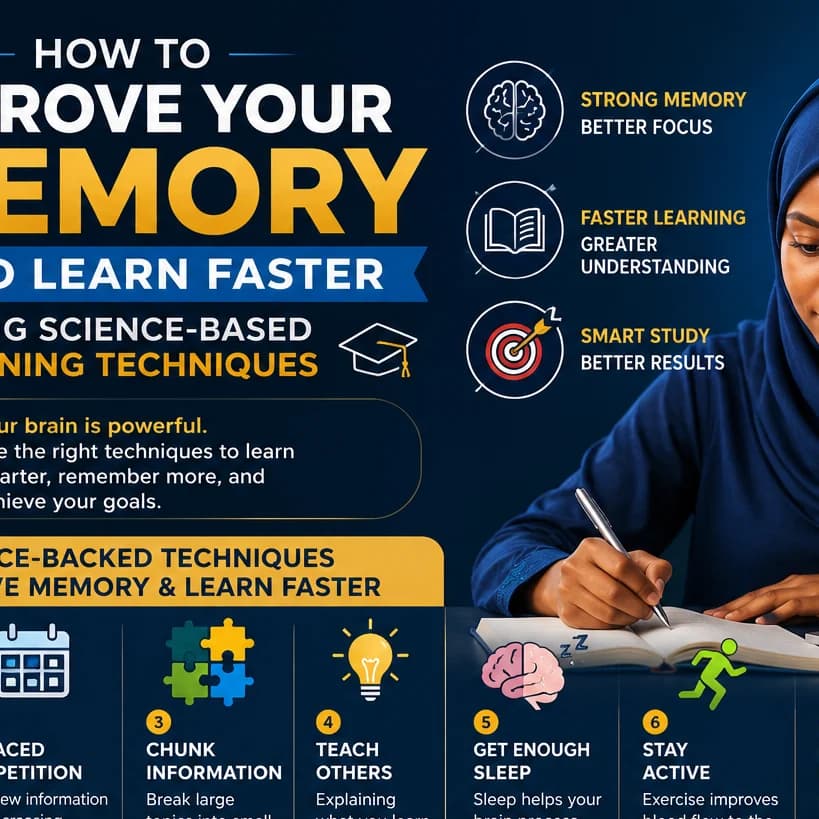
Enhancing memory isn't about innate talent; it's about cultivating effective learning habits. Techniques like active recall, spaced repetition, teaching others, chunking information, prioritizing sleep, staying active, and reducing distractions are backed by scientific research and can significantly enhance your learning capabilities.
Remember, progress in learning comes through consistency, not perfection. Small improvements each day can lead to remarkable results over time.
Whether you're a student, professional, or lifelong learner, investing in your memory is one of the most valuable investments you can make. Learn with intent, practice regularly, and let knowledge and wisdom guide your path to lifelong success.
Relate with me for more similar content @: https://bilkisu-hub.blogspot.com