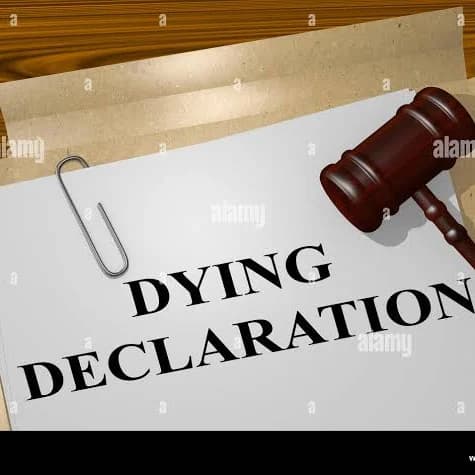
⚖️ DYING DECLARATION: WHEN A DEAD MAN'S WORDS SPEAK IN COURT
Imagine a man lying on his deathbed after a brutal attack. With his last strength, he points to his attacker and says:
"It was John who stabbed me."
A few hours later, he dies.
Can the court rely on those words even though the maker is no longer alive to testify?
The answer is YES.
Under Section 40 of the Evidence Act, 2011, a statement made by a person concerning the cause of his death or the circumstances leading to it is admissible where the person believed he was in danger of approaching death.
This is known as a Dying Declaration—one of the recognized exceptions to the rule against hearsay evidence.
The law proceeds on the principle that a person standing at the threshold of death is unlikely to deliberately tell lies. In the celebrated English case of R v. Woodcock (1789), the court stated that declarations made in the face of impending death carry a degree of solemnity comparable to evidence given under oath.
However, not every statement made before death qualifies as a dying declaration. The prosecution must establish that:
✅ The maker is dead;
✅ The statement relates to the cause or circumstances of the death;
✅ The cause of death is in issue before the court; and
✅ The deceased believed he was in danger of approaching death when the statement was made.
In Aminu Adamu v. State (2014), the Court reaffirmed that Section 40 of the Evidence Act codifies the doctrine of dying declaration in Nigeria.
📌 Legal Insight:
A dying declaration is not automatically conclusive proof of guilt. The court must still examine its credibility, consistency, and the surrounding circumstances before attaching weight to it.
The grave may silence a witness, but the law sometimes allows his final words to echo through the courtroom in the interest of justice.
B.I. AZUBUIKE Esq. ⚖️
Law For Everyone