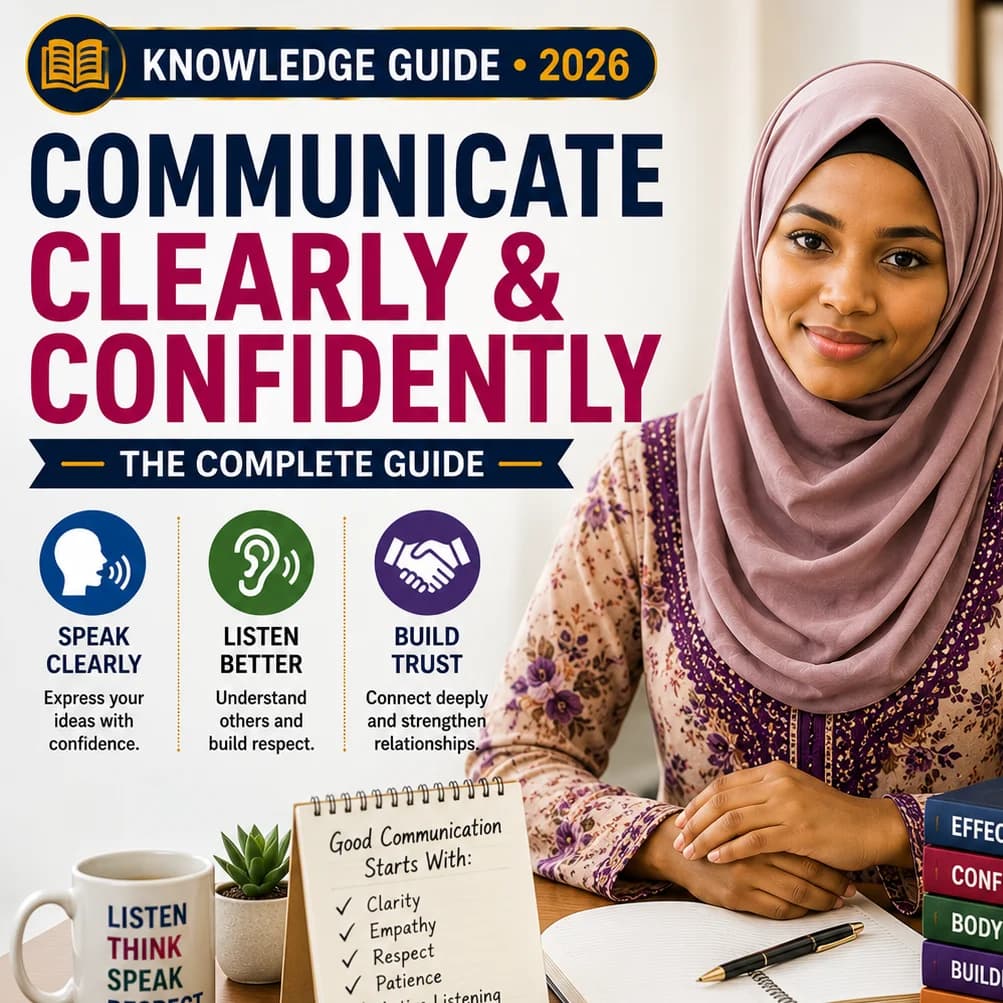
Learn how to communicate clearly and confidently in everyday life. Discover practical communication skills for speaking, listening, writing, handling disagreements, building trust, and expressing your ideas effectively.
Here is How to Communicate Clearly and Confidently:
how to communicate clearly and confidently
how to improve communication skills
effective communication skills for everyday life
how to speak confidently
how to become a better listener
communication skills for students and professionals
how to communicate effectively at work
how to handle difficult conversations
how to express yourself clearly
practical communication skills guide 2026
Introduction
Communication is one of the most important skills people use every day, yet many people underestimate or entirely neglected its importance. We communicate when we speak to family members, attend classes, work with colleagues, negotiate in business, send messages online, ask questions, solve disagreements, and share our ideas.
Having something to say is not at all enough but needed to be in hands with; Effective communicatio----- means expressing your thoughts clearly while also understanding what other people are trying to communicate.
A person can have excellent knowledge and strong ideas but struggle to share them effectively. On the other hand, someone who communicates clearly can build trust, avoid unnecessary misunderstandings, and create stronger relationships.
The good news is that communication is a skill that can be learned and improved through practice.
Table of Contents
-------------------------------
1. What Is Effective Communication?
2. Why Communication Skills Matter
3. Speaking vs Communicating
4. 10 Ways to Improve Communication
5. How to Become a Better Listener
6. How to Speak With Confidence
7. Non-Verbal Communication
8. Communicating Online
9. Handling Difficult Conversations
10. Common Communication Mistakes
11. Practical Daily Exercises
12. Frequently Asked Questions
13. Key Takeaways
14. An Ethical Perspective
15. Conclusion
16. Call to Action
What Is Effective Communication?
Effective communication is the ability to exchange information, ideas, feelings, and expectations in a way that can be understood by others.
It involves more than speaking. It includes listening, asking questions, observing reactions, choosing appropriate words, and adjusting your communication to the situation.
Good communication should be clear, respectful, purposeful, and appropriate for the audience.
Why Communication Skills Matter
Communication influences almost every area of life.
Students need communication skills to ask questions, participate in discussions, and present ideas.
Professionals need them for meetings, interviews, teamwork, negotiations, and leadership.
Entrepreneurs need communication to explain products, serve customers, build partnerships, and establish trust.
Families need communication to understand one another and resolve disagreements.
Strong communication can therefore become an important foundation for both personal and professional development.
The Difference Between Speaking and Communicating
Speaking means producing words. Communicating means ensuring that your intended message is understood.
For example, someone may use complicated language to demonstrate knowledge but leave the listener confused. Another person may explain the same idea using simple words and examples and achieve much better understanding.
Effective communicators focus not only on what they want to say but also on whether the other person understands it.
10 Ways to Improve Communication
1. Think Before You Speak
Taking a brief moment to organise your thoughts can make your message clearer.
Ask yourself what you want the other person to understand before you begin speaking.
2. Use Simple and Precise Language
Complicated words do not automatically make communication better.
Choose words that your audience can easily understand. When discussing difficult subjects, use examples or comparisons to make the idea clearer.
3. Listen Actively
Good communication is a two-way process.
Instead of planning your response while someone else is speaking, pay attention to their words, tone, and meaning.
Ask questions when something is unclear.
4. Ask Good Questions
Questions can prevent misunderstandings and encourage deeper conversations.
Instead of making assumptions, ask for clarification when necessary.
5. Pay Attention to Your Tone
The same words can communicate different meanings depending on how they are delivered.
A respectful tone can make difficult conversations easier, while an aggressive or dismissive tone can create unnecessary conflict.
6. Be Concise
Long explanations are not always better.
When possible, communicate the main point first and then provide additional details if necessary.
7. Adapt to Your Audience
Communication should match the situation.
The way you explain an idea to a child may be different from how you explain it to a professional colleague.
Consider the listener's knowledge, needs, expectations, and circumstances.
8. Use Examples
Examples make abstract ideas easier to understand.
If you are explaining a complicated concept, provide a simple real-life example that connects the idea to something familiar.
9. Confirm Understanding
When the subject is important, make sure everyone understands what has been communicated.
You can ask, "Does that make sense?" or invite the other person to ask questions.
10. Practise Empathy
Try to understand the situation from the other person's perspective.
You do not have to agree with someone to understand why they feel or think a certain way.
How to Become a Better Listener
Listening is one of the most underrated communication skills.
A good listener gives the speaker appropriate attention rather than constantly interrupting or immediately changing the subject.
Practise these habits:
Put distractions aside.
Maintain appropriate eye contact when speaking face-to-face.
Allow people to finish their thoughts.
Ask relevant questions.
Avoid judging too quickly.
Repeat or summarise important points when clarification is needed.
Good listening communicates something powerful: "Your words matter."
How to Speak With Confidence
Confidence does not mean speaking loudly or dominating conversations.
True communication confidence comes from preparation, knowledge, practice, and the ability to remain composed.
Before an important conversation or presentation, organise your main points.
Speak at a comfortable pace.
Avoid rushing because of nervousness.
Take natural pauses.
Focus on communicating your message rather than worrying excessively about how others perceive you.
Confidence grows through repeated experience.
Non-Verbal Communication
Communication is also expressed without words.
Facial expressions, posture, gestures, eye contact, personal space, and tone can influence how a message is received.
For example, someone saying "I'm listening" while constantly looking at their phone may communicate something very different through their behaviour.
Pay attention to whether your body language supports the message you are trying to communicate.
Communicating Online
Digital communication has become an important part of modern life.
Messages, emails, comments, social media posts, and online meetings can easily create misunderstandings because they often lack the facial expressions and tone available in face-to-face conversations.
Before sending an important message, read it again.
Ask yourself:
Could this sound rude or aggressive?
Is the meaning clear?
Did I provide enough context?
Am I responding emotionally?
Would a phone call or face-to-face conversation be more appropriate?
Taking a few seconds to review a message can prevent unnecessary conflict.
Handling Difficult Conversations
Difficult conversations are unavoidable.
Whether discussing a disagreement at work, addressing a misunderstanding with a friend, or negotiating a business problem, emotional control is important.
Focus on the issue rather than attacking the person.
Use calm language.
Explain how the situation affects you without making unnecessary accusations.
Listen to the other person's perspective.
Look for solutions rather than simply trying to prove that you are right.
If emotions become too intense, taking a short break can sometimes allow everyone to return to the conversation with a clearer mind.
Common Communication Mistakes
Interrupting people.
Assuming instead of asking.
Using unnecessarily complicated language.
Speaking while angry.
Ignoring the listener's perspective.
Sending emotional messages immediately.
Talking too much without making the main point clear.
Failing to listen to feedback.
Using insulting or disrespectful language.
These mistakes can damage trust even when the original message was reasonable.
Practical Daily Communication Exercises
Improving communication does not require a special course.
Try these simple exercises:
Spend one conversation each day practising active listening.
Explain one complicated idea using simple language.
Ask someone a thoughtful question instead of making an assumption.
Record yourself speaking and listen for unclear or repetitive phrases.
Before sending an important message, read it once more.
At the end of the day, think about one conversation that went well and one that could have gone better.
Small exercises repeated regularly can gradually improve communication.
Frequently Asked Questions
Can communication skills really be learned?
Yes. Communication improves through knowledge, observation, practice, feedback, and experience.
How can I become more confident when speaking?
Prepare your ideas, practise regularly, slow down your speech, and focus on communicating your message instead of trying to appear perfect.
What is the most important communication skill?
There is no single skill that solves every situation, but active listening is one of the most valuable because understanding others is essential to effective communication.
How can I communicate better during an argument?
Stay calm, listen carefully, focus on the issue rather than attacking the person, and look for a practical solution.
Is online communication different from face-to-face communication?
Yes. Online communication often lacks facial expressions and other non-verbal signals, so messages should be written especially clearly and thoughtfully.
Key Takeaways
• Good communication is more than speaking.
• Listening is just as important as talking.
• Simple language often produces clearer understanding.
• Confidence develops through preparation and practice.
• Tone and body language influence how messages are received.
• Asking questions reduces misunderstandings.
• Digital messages should be reviewed before sending.
• Difficult conversations require patience and emotional control.
• Empathy helps people understand different perspectives.
An Ethical Perspective on Communication
Words can build relationships or damage them.
Responsible communication should be guided by honesty, respect, patience, humility, and consideration for others. Having the ability to speak does not mean every thought must be expressed without reflection.
Good communication should not be used to manipulate, deceive, insult, or deliberately embarrass others.
The goal should be to communicate truthfully and respectfully while seeking understanding and constructive solutions.
When communication is guided by good character, it becomes more than a practical skill. It becomes a means of strengthening families, workplaces, communities, and society.
Conclusion
Clear communication is one of the most valuable skills anyone can develop. It helps people share knowledge, build relationships, solve problems, handle disagreements, and create opportunities.
You do not need to become a perfect speaker to communicate effectively. Start by listening more carefully, choosing your words thoughtfully, asking better questions, and learning to express your ideas simply.
With consistent practice, your communication can become clearer, more confident, and more respectful.
Remember: communication is not simply about making people hear your words. It is about helping people understand your message while making the effort to understand theirs.
Call to Action
Think about your communication today.
Are you speaking clearly? Are you listening carefully? Are you giving others enough opportunity to express themselves?
Choose one communication habit from this guide and practise it today.
Follow our Knowledge Guide Series for more practical guides on learning, personal development, digital skills, critical thinking, productivity, and responsible success.
You can also visit us @ https://bilkisu-hub.blogspot.com