Where the Guns Fell Silent: The Untold African Command Centre of the 1800s.
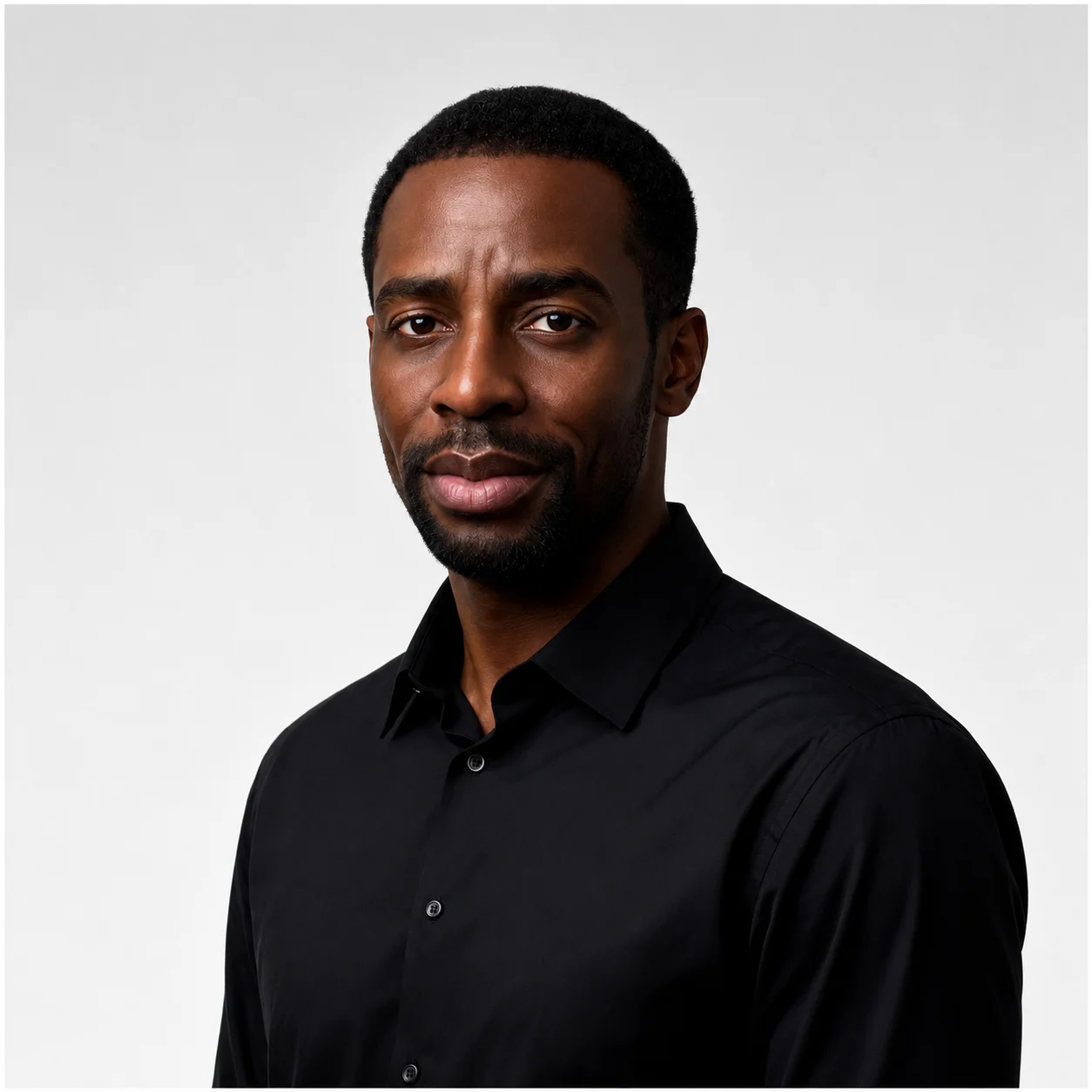
By Olajide Ojeniyi, ọmọ Ile-Agbo kan, Ogbomosho.
In the 19th century, West Africa was a continent at war. Empires fractured. Slave ports closed. New powers armed their rivals. Across the region, cities burned or bent to European guns. But in the flat savanna of what is now Nigeria, one city did something different. It built walls, took in refugees, and held. British officers who mapped the area called its fortifications formidable. Ibadan warlords used its men as shock troops. Yet no textbook calls it a command centre. That city was Ogbomosho, and its story changes how we understand colonization in Africa.
My name is Ojeniyi, and my roots are in Ile-Agbo kan, one of the compounds that guarded Ogbomosho’s gates when the gates still mattered. In our oriki, Oje confers honor, and Agbo speaks of strength. Those are not just words. They are instructions. My great grandfathers were hunters and warriors. They knew the paths through the savanna, the sound of a Dane gun at night, and the weight of holding a town together when the rest of the region was coming apart. This is not a lament for what colonialism took. It is an account of what Ogbomosho built, and what might have been if the region had recognized the command centre in its midst.
Ogbomosho was never meant to hold that role. It began with Soun Ogunlola, a hunter who tracked a wounded elephant to a pool and chose to settle. But hunters read land the way generals read maps. The ground was flat, defensible, and sat at the crossroads of every major route in Yoruba land. When Old Oyo collapsed after 1835 and Fulani cavalry pushed south, that accident of geography became destiny. Refugees did not run past Ogbomosho. They ran to it. Ikoyi people brought their cavalry traditions. Owu people brought their grief and their grit. And Ile-Agbo kan, along with the other warrior compounds, gave them all a wall to stand behind. By 1850, this was no longer a hunter’s camp. It was a fortress city with a standing army, gunmakers, and a reputation that stretched from Ilorin to the coast.
To understand that power, you have to step inside Ile-Agbo kan. Our compound was not built for comfort. It was built for war. The outer fence was high earth and thorns, with one narrow gate that forced any attacker into a choke point. Inside, the houses ringed a central courtyard where Dane guns were cleaned, charms were prepared, and boys learned to track by moonlight. Ojeniyi was not just a surname here. It was a role. Oje ni iyi means honor comes through Oje, the orisa of masquerade and medicine that guards warriors before battle. The elders of Ile-Agbo kan were custodians of that power. When Balogun Ajayi called for Ogbomosho men during the Kiriji War of 1877 to 1893, it was compounds like ours that answered first. We did not send farmers with cutlasses. We sent hunters who knew how to move in columns, how to encircle, how to hold ground. The same discipline that protected the compound became the discipline that held the city.
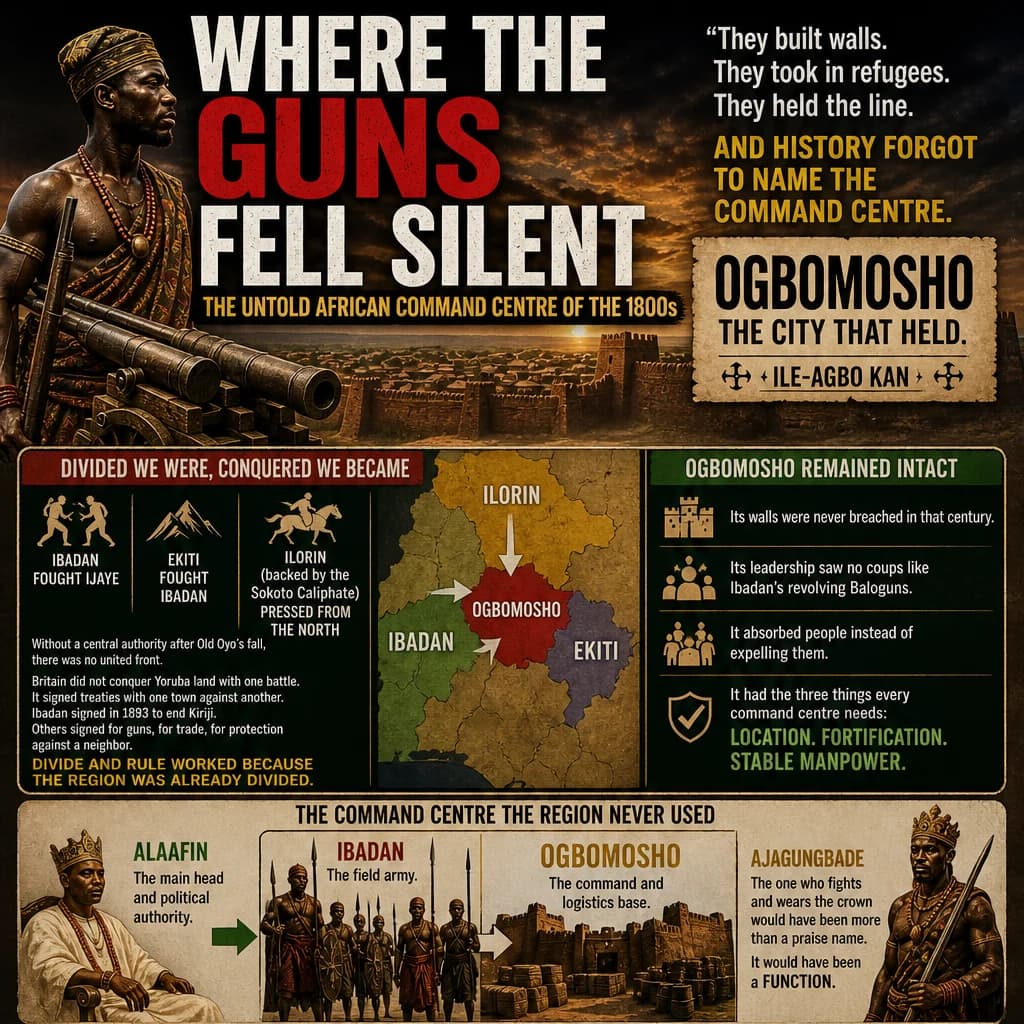
That discipline mattered because the 19th century was not one war but a chain of them. The Owu War, Jalumi, Kiriji. Each conflict drained gunpowder, killed leaders, and turned allies into rivals. Ibadan fought Ijaye. Ekiti fought Ibadan. Ilorin, backed by the Sokoto Caliphate, pressed from the north. Without a central authority after Old Oyo’s fall, there was no united front. Britain did not conquer Yoruba land with one battle. It signed treaties with one town against another. Ibadan signed in 1893 to end Kiriji. Others signed for guns, for trade, for protection against a neighbor. Divide and rule worked because the region was already divided.
Yet Ogbomosho remained intact. Its walls were never breached in that century. Its leadership saw no coups like Ibadan’s revolving Baloguns. It absorbed people instead of expelling them. In military terms, it had the three things every command centre needs: location, fortification, and stable manpower. If the Yoruba states had united under one strategy, the Alaafin would have remained the main head and political authority, Ibadan the field army, and Ogbomosho the command and logistics base. Ajagungbade, the one who fights and wears the crown, would have been more than a praise name. It would have been a function
Britain had advantages beyond African disunity. Maxim guns, quinine, telegraph lines, and the backing of the Berlin Conference of 1884 to 1885 all tilted the field. Even a united front would have faced a hard fight. But unity changes the cost of conquest. The British took Benin in a week in 1897. They spent years negotiating with Yoruba towns because the military math was different. A coordinated defense using Ogbomosho as the base, Ibadan’s army, and Ekiti’s hills would have forced London to choose between a long war and a different kind of treaty.
That is the untold role. Ogbomosho was the command centre the region never used. The evidence sits in the walls that still stand, in compounds like Ile-Agbo kan where war was a craft, and in the record of a city that kept taking in strangers until it became stronger than the sum of its parts. Today, Ajagungbade lives in new ways. You find it in Ogbomosho people in Lagos, in London, and here in Dar es Salaam where I write this. The walls are now stories. The court yard is now memory. But the instruction remains: Oje ni iyi. Honor comes through Oje. And sometimes, honor means telling the story of the command centre that history forgot to name.
If we remember that, we remember more than a town. We remember a model of survival built on discipline, refuge, and strategy. Colonization was not fate. It was the outcome of choices, battles, and missed alliances. Ogbomosho shows us the other path that existed. The path where the guns fell silent because the centre held.
About the Author.
Olajide Ojeniyi is a passionate advocate for innovation, creativity, and entrepreneurship. With experience in research, leadership, and mentorship, he is dedicated to empowering young people to become creative problem-solvers and change-makers. Olajide is committed to fostering a culture of innovation and entrepreneurship in Africa. He is a member of the World Bank's Solutions for Youth Employment (S4YE) Youth Advisory Group, where he contributes to global efforts to address youth unemployment and promote sustainable livelihoods. He believes that by harnessing the potential of young minds, we can create a brighter future for all.