Have you ever wondered why some people seem to have a strong body odour even when they bathe regularly?
Or why someone's body odour appears to become stronger after eating certain foods?
Here's something many people don't know:
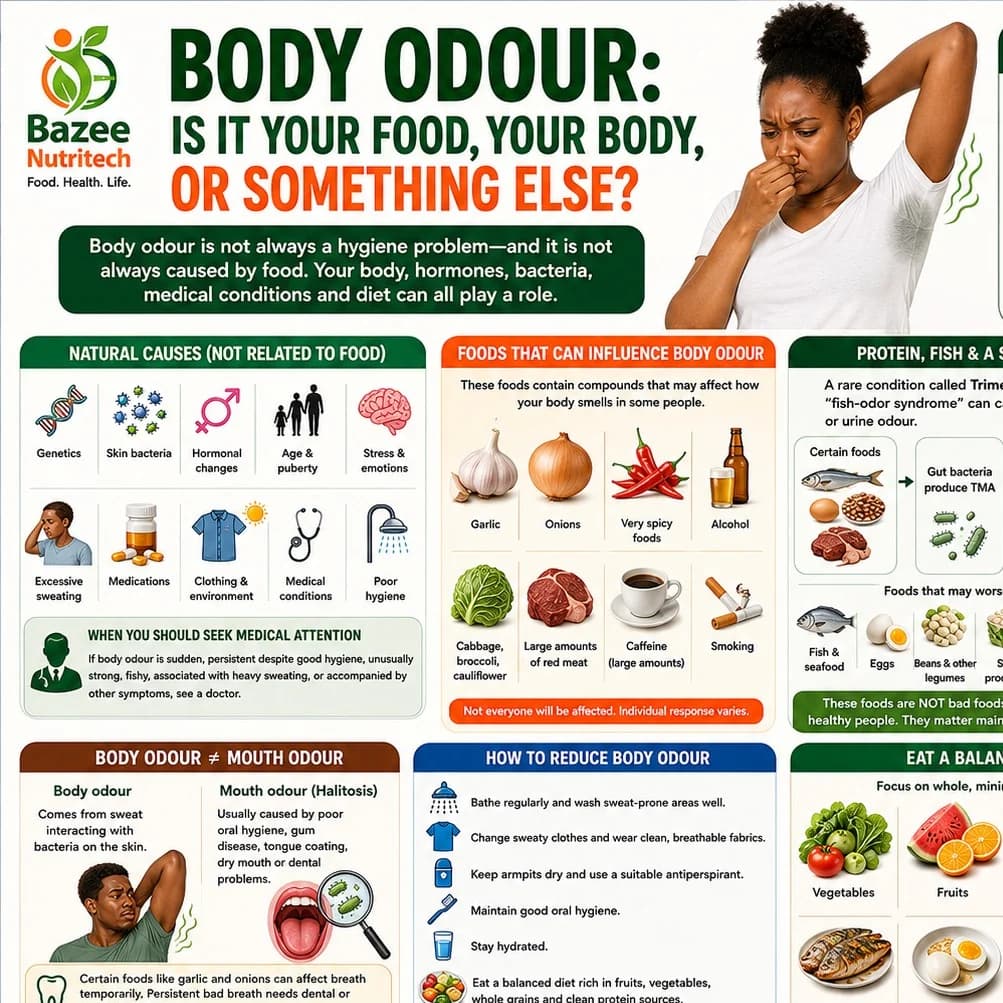
Body odour is not always a hygiene problem—and it is not always caused by food.
Sometimes, your body's natural chemistry, hormones, skin bacteria, medical conditions or even genetics can play a role.
And yes, nutrition can influence body odour in certain situations.
Let's break it down.
🧬 FIRST: WHAT ACTUALLY CAUSES BODY ODOUR?
Fresh sweat itself is generally not strongly smelly.
The characteristic smell develops when secretions from sweat glands interact with microorganisms on the skin. This is particularly important around the armpits, groin and other areas where apocrine glands are present.
This condition of excessive or abnormal body odour is medically known as bromhidrosis.
So someone can have good personal hygiene and still experience noticeable body odour.
👃 CAN SOME PEOPLE HAVE A "NATURAL" BODY ODOUR?
Yes.
Everyone has an individual body scent influenced by:
• Genetics
• Skin bacteria
• Sweat production
• Hormonal changes
• Age and puberty
• Stress and emotional changes
• Clothing and environmental temperature
• Personal hygiene
• Certain medications
There is also a genetic variation involving the ABCC11 gene that is strongly associated with differences in underarm odour production.
This means that two people can have similar hygiene habits but naturally have different levels or characteristics of body odour.
🥵 WHY DOES BODY ODOUR BECOME STRONGER IN NIGERIA?
Think about our environment.
Nigeria is generally warm and, in many regions, humid.
Heat increases sweating.
If sweat remains on the skin for prolonged periods, especially around the armpits and groin, the interaction between sweat and skin microorganisms can make odour more noticeable.
This is why good hygiene, breathable clothing, changing sweaty clothes and appropriate antiperspirant use can be important.
🍛 NOW LET'S TALK ABOUT FOOD
Food can influence body odour—but usually not in the way people think.
Certain foods contain volatile or sulfur-containing compounds that may be released through the breath, sweat or other body fluids.
Examples include:
🧄 Garlic
🧅 Onions
🌶️ Very spicy foods
🥬 Cabbage, broccoli and cauliflower
🥩 Large amounts of red meat
🍺 Alcohol
These foods do not automatically cause body odour in everyone. Individual responses vary. Some may increase sweating, while compounds from others can contribute to a noticeable smell.
So please don't conclude:
"Garlic causes body odour in everybody."
That's not scientifically accurate.
🐟 BUT HERE IS THE INTERESTING PART ABOUT PROTEIN
This is where things become clinically interesting.
Fish, eggs, beans and some other protein-containing foods can be relevant in a rare condition called trimethylaminuria (TMAU).
TMAU is sometimes called fish-odor syndrome.
People with this condition can develop a persistent smell resembling rotten or decaying fish because their body has difficulty breaking down a compound called trimethylamine (TMA).
The normal pathway is:
Certain foods → gut bacteria produce trimethylamine → liver enzyme FMO3 converts it into a much less odorous compound.
In TMAU, this process doesn't work properly, particularly because of impaired FMO3 activity.
The result?
TMA can accumulate and be released through:
• Sweat
• Breath
• Urine
• Other body secretions
producing the characteristic fishy smell.
🍳 WHICH FOODS CAN MATTER IN TMAU?
Foods containing precursors of trimethylamine may worsen symptoms in affected individuals.
These can include:
🐟 Certain fish and seafood
🥚 Eggs
🫘 Beans and other legumes
🥩 Liver and other organ meats
🥜 Peanuts
🌱 Soy products
🥦 Some cruciferous vegetables such as cabbage and cauliflower
The important point is:
These foods are NOT generally "bad foods" and they do NOT cause TMAU in healthy people.
They become particularly relevant when someone has this metabolic condition.
So if you eat beans or fish and don't develop a fishy body odour, you don't need to stop eating them.
🇳🇬 WHAT ABOUT OUR COMMON NIGERIAN PROTEINS?
Let's make this practical.
🐟 Fish
Fish is an excellent source of protein and important nutrients.
However, someone with TMAU may notice worsening fish-like odour after certain seafood, particularly fish high in trimethylamine/TMAO precursors.
This does not mean Nigerians should stop eating fish.
🥚 Eggs
Eggs are nutritious and affordable sources of protein.
But eggs contain choline, which can contribute to TMA production in susceptible individuals.
Again, this is particularly relevant to someone with TMAU—not the general population.
🫘 Beans
Beans are one of Nigeria's most valuable affordable protein and fibre sources.
They contain compounds that can contribute to TMA production, but beans do not normally cause abnormal body odour in healthy people.
Someone with suspected TMAU may need individualized dietary modification rather than simply eliminating beans independently.
🥩 Meat
Red meat contains compounds that may influence body odour in some circumstances, but there is no reason for a healthy person to completely eliminate meat simply because of body odour.
The focus should be on dietary balance and identifying individual triggers.
👄 WAIT—WHAT ABOUT MOUTH ODOUR?
This is where we need to separate two things:
BODY ODOUR ≠ MOUTH ODOUR.
Bad breath is called halitosis and commonly has an oral cause.
Poor oral hygiene, tongue coating, gum disease, dental problems and dry mouth can contribute significantly.
Certain foods can temporarily affect breath—for example garlic and onions.
But if someone has persistent mouth odour, the answer isn't simply:
"Drink more water."
The person may need a dental or medical assessment.
Interestingly, people with TMAU can also have fishy-smelling breath because TMA can be released through the breath.
🚨 WHEN SHOULD YOU SUSPECT THAT SOMETHING MORE THAN FOOD IS HAPPENING?
Pay attention if the odour:
• Has been persistent despite good hygiene
• Started suddenly without an obvious explanation
• Has a very unusual or fish-like character
• Is also noticeable in the breath or urine
• Is associated with excessive sweating
• Is accompanied by other unexplained symptoms
• Has a significant impact on your social life
Persistent or unusual body odour can sometimes be associated with medical conditions, medications or metabolic disorders and deserves proper assessment rather than endless experimentation with foods.
🧼 SO HOW CAN YOU REDUCE ORDINARY BODY ODOUR?
Start with the basics:
✅ Bathe regularly and wash areas prone to sweating thoroughly.
✅ Change sweaty clothes promptly.
✅ Wear clean, breathable clothing.
✅ Keep the armpits dry.
✅ Consider an appropriate antiperspirant if excessive sweating is contributing to the problem.
✅ Maintain good oral hygiene.
✅ Stay adequately hydrated.
✅ Eat a balanced diet rather than unnecessarily eliminating nutritious foods.
For bromhidrosis, medical treatment may sometimes include antiseptic washing, topical treatments, antiperspirants or other interventions depending on the cause.
🥗 AND WHAT SHOULD YOU DO ABOUT YOUR DIET?
Don't start eliminating fish, eggs, beans or meat just because someone told you they cause body odour.
Instead:
Observe → Identify a consistent trigger → Discuss it with a healthcare professional → Make an appropriate dietary adjustment if necessary.
If TMAU is suspected, diagnosis can involve measuring trimethylamine-related compounds in urine, and dietary management should ideally be individualized by a healthcare professional, particularly a dietitian familiar with metabolic disorders.
🧠 THE BIG LESSON
Not every body odour is caused by poor hygiene.
Not every body odour is caused by food.
And not every protein causes body odour.
For most people, body odour is primarily related to sweat, skin microorganisms, hormones, genetics, hygiene and environmental factors.
For some people, certain foods can influence the smell.
And for a very small number of people, a metabolic condition such as trimethylaminuria can produce a characteristic fishy odour that requires proper assessment.
So before you completely remove fish, eggs or beans from your Nigerian diet, find out what is actually causing the smell.
💬 LET'S DISCUSS
Have you ever noticed that a particular food makes your body odour or breath stronger?
Which food did you notice—and did the smell disappear when you stopped eating it?
#BodyOdour #Nutrition #NigerianNutrition #Dietitian #HealthEducation #Bromhidrosis #Trimethylaminuria #HealthyEating #NutritionEducation #Feedcover #Nigeria #FoodAndHealth