
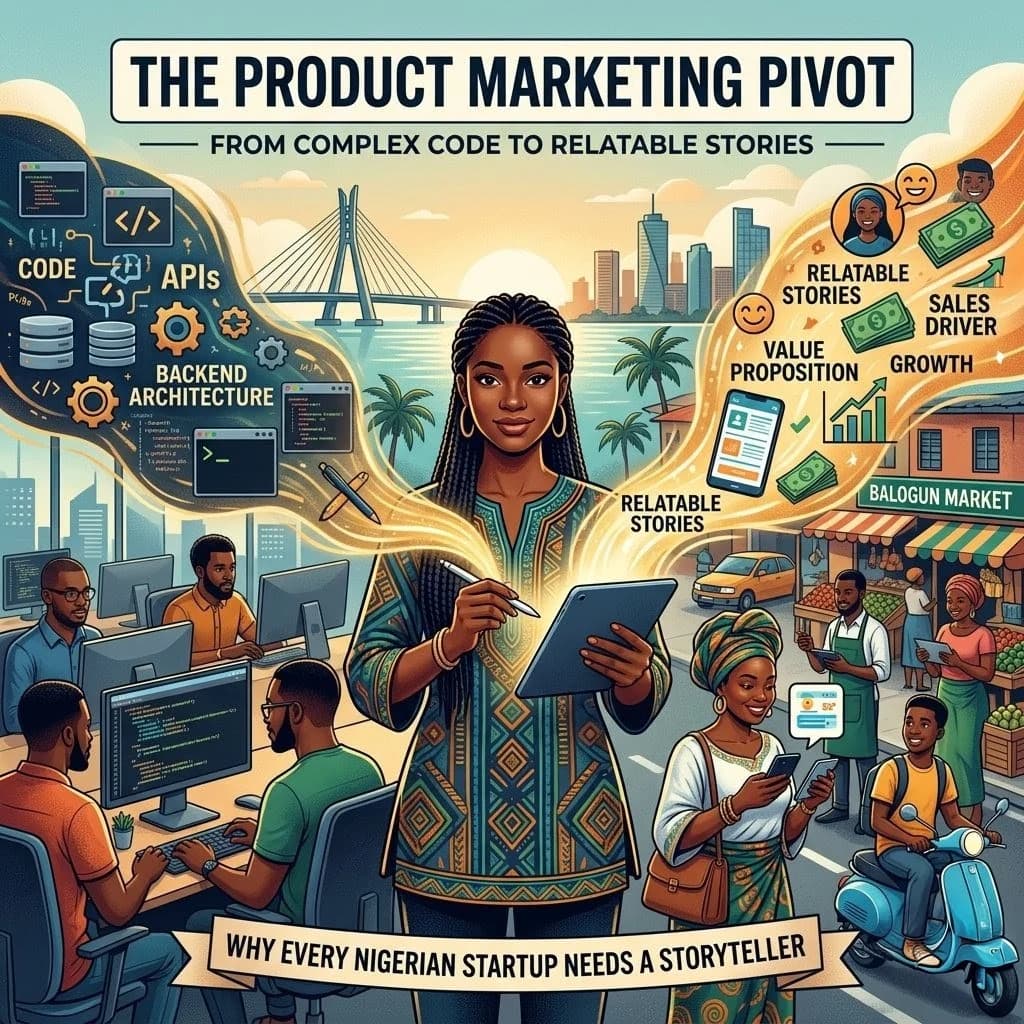
How to Become a High-Earning, Non-Coding Tech Storyteller: Bridging the Gap Between Code and Consumers
The African tech ecosystem has undergone a massive paradigm shift. The era of the "build it and they will come" philosophy fueled by the historical venture capital blitz of the early 2020s has officially drawn to a close.
As global macroeconomic tightening forces local startups to prioritize revenue generation over vanity metrics, a glaring systemic vulnerability has been exposed: Nigeria possesses some of the finest software engineers on the continent, yet many of these tech ecosystems struggle with customer acquisition because they fail to articulate their value proposition.
They build the features, but they forget the feeling.
To survive this era of capital discipline, founders are pivoting away from aggressive, top-of-funnel brand spending and turning to a critical, often underutilized non-coding executive: the Product Marketing Manager (PMM). Now positioned as one of the highest-paying non-technical roles in global technology, product marketing has emerged as the ultimate bridge between complex software architecture and the everyday realities of the African consumer.
What is Product Marketing? (And How It Differs From Growth Marketing)
A frequent point of failure in many corporate structures is the conflation of product marketing with traditional or growth marketing. While both functions live within the broader commercial apparatus, their objectives, KPIs, and methodologies diverge sharply.
Traditional and growth marketing are fundamentally focused on the top of the funnel. These domains ask: How many users can we attract to the platform this month? Their primary objectives center around driving traffic, generating raw leads, optimizing digital ad spend, and boosting general brand awareness. Their deliverables are visible in PPC campaigns, SEO content pipelines, social media engagement, and performance advertising designed to pull strangers into the ecosystem.
Product marketing, conversely, is obsessed with the value proposition and the entire product life cycle. It asks: Once those 10,000 users arrive, what is the exact messaging framework that convinces them to deposit money within the first 90 seconds? How do we arm our B2B sales teams with the collateral needed to close enterprise deals? Instead of focusing on how many people arrive, the PMM defines why a specific user persona should care and establishes the strategy to ensure they stay. Their deliverables are deeply strategic: Ideal Customer Profile (ICP) definitions, messaging frameworks, product launch playbooks, and competitive battlecards.
The PMM serves as the strategic connective tissue between three distinct, often misaligned stakeholders:
[ Product Team ]
(Builds Value)
│
▼
[ Product Marketing ] ◄───► [ Nigerian Consumer ]
(Translates Value) (Experiences Value)
▲
│
[ Sales Team ]
(Monetizes Value)
The Product Team: PMMs feed customer insights back to engineers to ensure the product roadmap aligns with actual market demand.
The Sales and Go-To-Market (GTM) Teams: PMMs synthesize technical capabilities into commercial toolkits, objection-handling scripts, and collateral.
The Local Consumer: PMMs translate engineering architecture into culturally resonant narratives that solve immediate, real-world problems.
The Core Competencies of a High-Earning PMM
Entering this high-income bracket requires a specialized cross-section of data analysis, psychological intuition, and strategic communication. Top-tier tech companies look for several foundational pillars when hiring a PMM:
1. Granular Customer Research & Persona Architecture
An elite PMM does not rely on generic demographic data. They understand that user behavior in Nigeria is highly contextualized, fragmented, and socio-economically nuanced.
Developing this skill involves conducting deep ethnographic research. A PMM must possess the versatility to interview a tech founder in Yaba to understand their enterprise SaaS bottlenecks, and the next day stand in Balogun or Ariaria international market, interviewing informal traders to decipher why they prefer cash-on-delivery over automated digital wallets. This research is used to construct ICPs that dictate product design and commercial copy.
2. Strategic Positioning and Narrative Design
Positioning is the mental real estate your product occupies in the mind of the consumer relative to the competition. Messaging is the verbal expression of that positioning.
With human attention spans hovering around eight seconds, a PMM must master the art of the 3-second value proposition. When a prospect lands on a startup's digital real estate, they must immediately understand what the product is, who it is for, and why they should care.
The PMM Formula: Instead of an engineering-focused headline like "We leverage cross-border ledger APIs with 99.9% uptime," an elite PMM rewrites it to target the emotional and operational pain point: "Pay your global suppliers in minutes, without the bank queues or FX headaches."
3. Competitive Intelligence and Defensive Positioning
In crowded sectors like African fintech, logistics, and proptech, product homogenization is a constant threat. High-earning PMMs build systematic frameworks to track competitor feature rollouts, pricing structures, and marketing strategies. By creating internal documentation like "competitor battlecards," they train sales representatives on how to counter client objections and position their startup as the structurally superior choice.
A Step-by-Step Professional Learning Path
Transitioning into product marketing does not require a computer science degree or a formal business school background. It demands a structured approach to mastering the Go-To-Market playbook.
Phase 1: Establish a Theoretical Foundation
Before attempting to market products, you must learn the industry-standard methodologies. Focus on obtaining globally recognized, free certifications to validate your foundational knowledge:
Product Marketing Alliance (PMA) Core Frameworks: The PMA offers foundational content, templates, and free introductory courses that detail the lifecycle of a product launch.
HubSpot Product Marketing Certification: This course bridges the gap between traditional content strategy and product-led growth mechanics, focusing heavily on inbound methodologies.
Pragmatic Institute Framework: Familiarize yourself with their highly regarded matrix detailing product management and marketing lifecycles.
Phase 2: Build a Proof-of-Concept Portfolio (The "Deconstruct & Rebuild" Method)
The most common hurdle for aspiring PMMs is the "experience paradox" companies demand a track record, but you cannot get a role without one. To bypass this, you can build a portfolio using public case studies.
Identify the Target: Locate an active Nigerian or African application (web or mobile) that features a brilliant technical product but suffers from confusing branding, poor UX copy, or disjointed onboarding flows.
Execute the Audit: Write a comprehensive critique analyzing their current positioning. Explain why their messaging fails to connect with their target demographic.
The Strategic Redesign: Craft a brand-new messaging framework. Write the new landing page copy, design a mock email onboarding sequence, and detail a theoretical Go-To-Market strategy for their next feature release.
Publish and Distribute: Package this audit into an analytical, professional long-form post on platforms like Medium or LinkedIn.
By tagging the startup founders or product leaders in a constructive, highly strategic manner, you transform passive learning into active industry visibility. In the modern tech landscape, a singular, deeply analytical case study that demonstrates structured thinking is often more valuable than an abstract resume.