
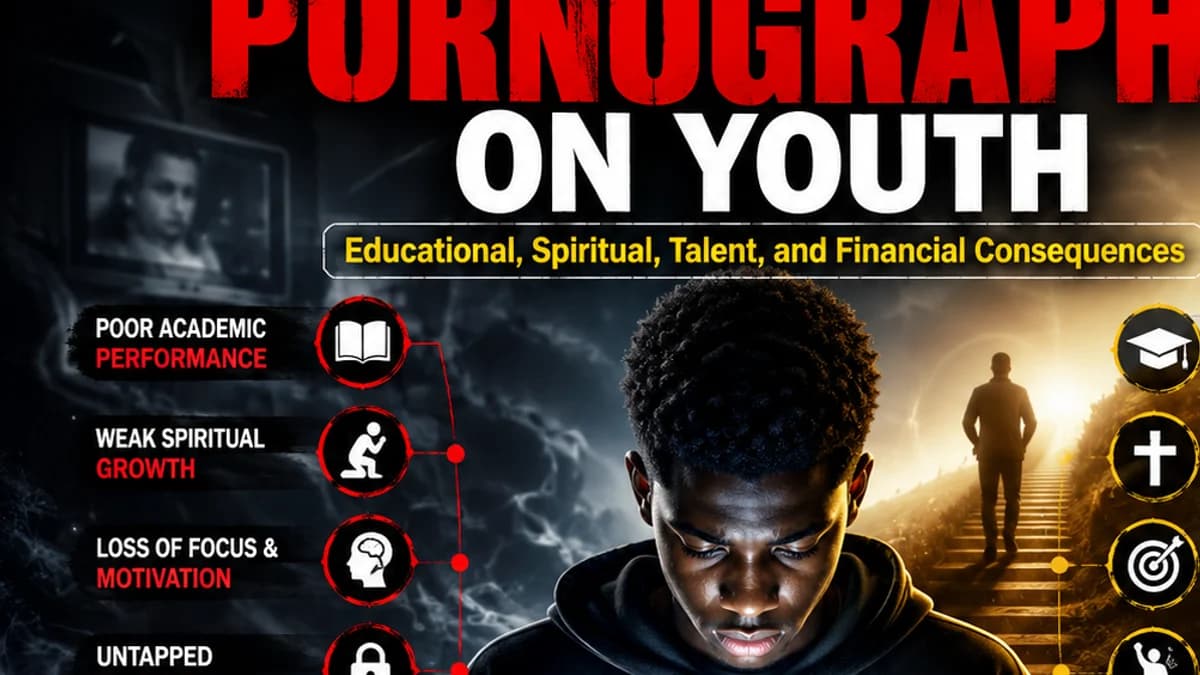
THE EFFECTS OF PORNOGRAPHY ON YOUTH
Educational, Spiritual, Talent, and Financial Consequences
Introduction
Youth is one of the most important stages of life. It is a period for acquiring knowledge, developing character, discovering talents, building relationships, and preparing for the future. What a young person repeatedly gives attention to can strongly influence his or her habits, priorities, and direction in life.
Pornography is sexually explicit material produced primarily for sexual stimulation. Because smartphones and the internet have made sexually explicit content easily accessible, young people can encounter it without fully understanding its potential consequences. The World Health Organization has specifically highlighted concerns about pornography becoming a default source of sexual information for some young people and its possible effects on understanding consent, mutual respect, sexual health, and gender equality.
It is important to discuss this subject without shame or condemnation. A young person struggling with pornography is not a hopeless person. With education, discipline, supportive relationships, and, where necessary, professional help, harmful patterns can be changed.
1. Educational Effects
One of the greatest dangers of excessive pornography consumption is the way it can compete with education for a young person's attention.
A student who repeatedly spends significant time searching for, watching, or thinking about pornography may gradually sacrifice time that could have been invested in studying, reading, learning a trade, developing a skill, or preparing for examinations.
Loss of concentration
Education requires sustained attention. Constantly seeking highly stimulating digital content can make ordinary academic activities feel less interesting by comparison. This can contribute to procrastination and difficulty maintaining productive routines.
The adolescent years are also a major period of neurological development. The brain systems involved in reward, decision-making, impulse control, and planning continue developing throughout adolescence.
Reduced academic productivity
The problem is not simply the existence of sexual thoughts. The greater concern is when pornography becomes a repetitive habit that consumes time and mental energy.
A young person may begin saying:
«"I will study after watching this."»
But one video becomes another, and the study period disappears.
Eventually, hours that could have been invested in education can become hours invested in a habit that produces no academic qualification, professional skill, or lasting achievement.
Distorted sexual education
Pornography is entertainment, not a reliable sexuality-education curriculum. It may present unrealistic bodies, relationships, sexual behaviour, and expectations.
The APA notes that graphic pornographic material can distort adolescents' understanding of healthy relationships and influence sexual beliefs, thoughts, and behaviours.
This is why young people need accurate, age-appropriate education about relationships, consent, respect, health, boundaries, and responsibility rather than learning about sexuality primarily from pornography. WHO recommends scientifically accurate and age-appropriate sexuality education for young people.
2. Spiritual Effects
From a spiritual perspective, many religious traditions teach that the eyes, mind, thoughts, and desires should be disciplined.
For Christians, for example, the Bible teaches the importance of guarding one's heart and mind and avoiding sexual immorality. Jesus also emphasized the importance of what a person allows into the heart and mind.
Pornography can therefore become a spiritual battle because it encourages a person to repeatedly entertain sexual images and fantasies rather than developing self-control, purity, discipline, love, and respect.
It can weaken spiritual discipline
A young person who regularly consumes pornography may begin to spend less time praying, studying Scripture, attending fellowship, serving others, or developing spiritual character.
The danger is not simply missing one spiritual activity. It is the gradual replacement of meaningful activities with a private habit.
Guilt and spiritual isolation
After repeatedly engaging in behaviour that conflicts with one's values, a person may experience guilt, shame, secrecy, and discouragement.
Some may begin thinking:
«"God will no longer accept me."»
That conclusion is destructive.
For Christians, repentance means turning away from destructive behaviour and returning to God. A person struggling with pornography should seek forgiveness, accountability, and practical change rather than surrendering to shame.
The battle for the mind
Spiritual growth requires discipline. What repeatedly occupies the mind can influence desires, attitudes, and behaviour.
Therefore, overcoming pornography is not merely about saying, "I will never watch it again." It also involves replacing the habit with healthier activities: prayer, Scripture, exercise, productive work, education, service, meaningful friendships, and purposeful goals.
3. Loss of Talent
One of the most overlooked consequences is lost potential.
Every young person has abilities that can be developed. Someone may have the potential to become an engineer, teacher, entrepreneur, musician, athlete, artist, programmer, craftsman, leader, or business owner.
But talent does not develop automatically.
Talent requires:
Time + Practice + Discipline + Knowledge + Consistency = Development
When excessive pornography consumption becomes a major part of someone's life, time and attention can be diverted away from these things.
Imagine two young people with equal talent.
One spends several hours every week learning coding, playing an instrument, studying business, exercising, reading, or developing a trade.
The other repeatedly spends those hours consuming pornography and scrolling for more stimulating content.
After several years, their abilities may be dramatically different.
The first person has accumulated skills.
The second may have accumulated a habit.
That is why pornography can represent a loss of talent—not because it physically removes someone's ability, but because time, attention, motivation, and opportunities for development can be consumed by an unproductive habit.
4. Loss of Wealth and Financial Potential
Pornography can also have an economic dimension.
Money represents more than cash. It represents time, labour, opportunity, and future possibilities.
A young person who spends money on pornography, premium content, subscriptions, dating platforms, or related digital services is transferring financial resources toward immediate gratification rather than long-term development.
More importantly, the greatest financial loss can be indirect.
Consider the following:
Lost hours → reduced productivity → fewer skills → fewer opportunities → lower earning potential.
A young person who could have used several hours every week to learn a profitable skill may instead spend those hours in a repetitive cycle of watching pornography.
Over five or ten years, the opportunity cost can become significant.
For example, a young person could spend those same hours learning:
- Programming
- Graphic design
- Video editing
- Digital marketing
- Welding
- Plumbing
- Electrical work
- Fashion design
- Trading with proper risk management
- Construction skills
- Entrepreneurship
- Communication and leadership
The goal is not simply to "stop watching pornography."
The greater goal is to recover the time and redirect it toward building a valuable life.
5. Effects on Relationships
Pornography can also create unrealistic expectations about intimacy and relationships.
Real relationships require communication, patience, respect, responsibility, trust, emotional connection, and consent.
Pornographic material may not accurately represent these realities. WHO has raised concerns about pornography's potential implications for young people's understanding of consent, mutual respect, sexual health, and gender equality.
A young person who learns primarily from pornography may therefore develop expectations that do not reflect healthy relationships.
6. The Cycle of Habit
A common danger with any repetitive digital behaviour is the development of a cycle:
Trigger → urge → pornography → temporary gratification → regret → another trigger → repetition.
Triggers may include:
- Loneliness
- Boredom
- Stress
- Being alone with a phone
- Social-media content
- Late-night internet use
- Sexualized entertainment
- Emotional frustration
Breaking the cycle requires identifying the trigger rather than fighting only the final behaviour.
7. How Young People Can Break Free
1. Make a deliberate decision
Do not treat the problem casually. Decide what kind of person you want to become and why you want to change.
2. Remove easy access
Use content filters, block explicit websites, unfollow sexualized accounts, and avoid keeping the phone in private situations where you repeatedly fall into the habit.
3. Replace the habit
Empty time creates opportunities for old habits to return.
Replace pornography with constructive activities:
Exercise + Reading + Prayer + Work + Learning + Healthy friendships.
4. Develop a purpose
A person with a meaningful goal has something greater to protect.
Ask yourself:
What skill can I master in the next year?
What career can I build?
What business can I start?
What talent have I neglected?
What kind of person do I want to become?
5. Seek accountability
Talk to a trusted parent, mentor, pastor, counsellor, teacher, or another responsible adult. You do not have to fight a destructive habit completely alone.
6. Don't allow failure to become an identity
A relapse does not mean that a person is permanently defeated. Identify what triggered it, change the environment, and begin again.
If the behaviour has become compulsive or is seriously interfering with school, work, relationships, or daily life, professional counselling can also be appropriate.
8. A Spiritual Perspective on Recovery
For a Christian young person, recovery can involve both spiritual and practical action.
Pray for strength.
Study Scripture.
Avoid environments that repeatedly trigger temptation.
Seek accountability.
Serve others.
Develop useful skills.
Keep your mind occupied with meaningful activities.
Most importantly, understand that spiritual growth is not achieved through shame. It is achieved through repentance, faith, discipline, grace, and continuous transformation.
Conclusion: Don't Trade Your Future for Temporary Pleasure
The greatest question is not:
"Can pornography give me pleasure?"
The greater question is:
"What is this habit costing me?"
It may cost time.
It may cost concentration.
It may affect one's understanding of relationships.
It may weaken personal discipline.
It may interfere with spiritual priorities.
It may prevent talents from being developed.
And it may represent years of lost opportunity that could have been used to build skills, wealth, character, and a meaningful future.
Youth is a season of preparation. Do not exchange your future for temporary stimulation.
Your mind is valuable.
Your time is valuable.
Your talent is valuable.
Your future is valuable.
Your spiritual life is valuable.
Invest these things wisely.
Don't allow a few minutes of temporary pleasure to steal years of your potential.
The good news is that change is possible. The same time that was once wasted can be redirected into education. The same energy that was once consumed by a destructive habit can be invested in talent. The same mind that was distracted can become focused. And the same young person who once struggled can become disciplined, productive, spiritually grounded, and purposeful.
Your past does not have to determine your future. What you choose to do with your life from today can change its direction.