The opening months of 2026 find the Nigerian tech landscape moving far beyond the novelty of "chatting" with machines. While 2024 and 2025 were defined by generative AI tools that could write an email or create an image this year belongs to Agentic AI in Nigeria.
To understand the change, one must look at the distinction: A chatbot talks to you, but an AI Agent acts for you. Using a local analogy, a chatbot is like a consultant who gives you a strategy for your business; an AI Agent is the trusted staff member who goes to the market, negotiates the price, buys the goods, and returns with the change and a receipt.
Section 1: Defining the "AI Agent"
At its core, Agentic AI refers to software systems designed to achieve specific goals autonomously. Unlike traditional AI that requires a human to click "next" at every stage, an agent can use tools, browse the web, and complete multi-step workflows independently.
The industry has shifted from Generative AI (content creation) to Agentic AI (execution). These agents don't just "know" things; they "do" things. They can reason through a problem, break it into smaller tasks, and iterate until the objective is met.
Section 2: Real-World Use Cases for the Nigerian Professional
The impact of this shift is being felt across various sectors in Lagos, Abuja, and beyond:
The Auto-Researcher: For freelance writers or post-graduate students, agents now scan dozens of Nigerian news outlets and journals simultaneously. An agent can summarize the week’s macroeconomic trends and draft a formatted report while the user is asleep.
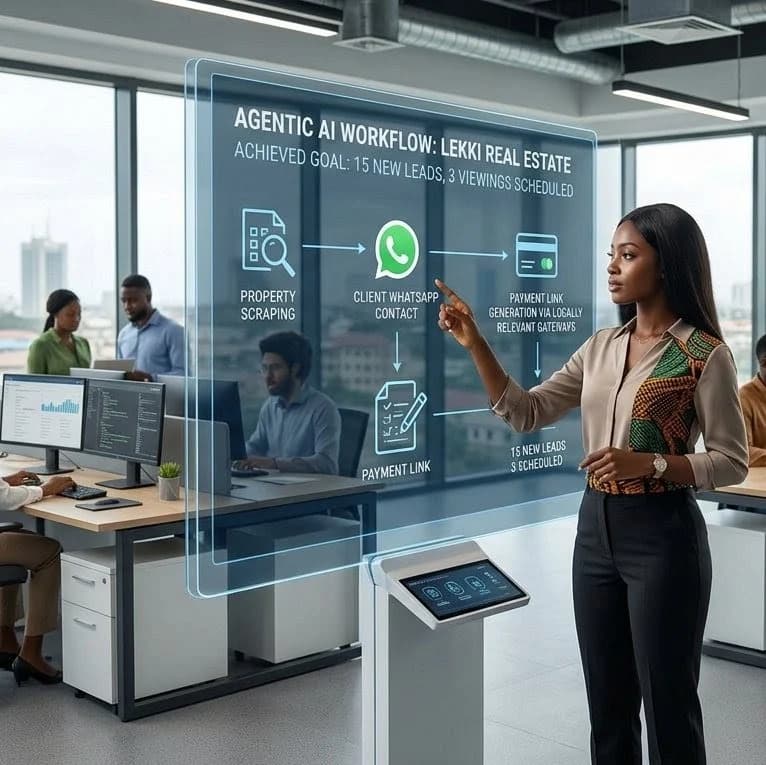
The Lead Hunter: Real estate professionals in Lekki and Ikeja are deploying agents to monitor property listings across multiple platforms. When a match is found, the agent automatically triggers an introductory WhatsApp message to the owner, ensuring the agent is always the first to reach a lead.
The Customer Success Agent: Retail brands are moving past "How much?" FAQs. Modern agents check real-time stock levels, calculate dynamic delivery fees to specific Local Government Areas (LGAs), and generate secure payment links instantly.
Section 3: Localization Agents That Understand "Naira and Kobo"
A significant driver of adoption in 2026 is the rise of African-centric models. These agents are fine-tuned to understand local nuances, from Pidgin English to the specific logistics hurdles of "Last Mile" delivery in Nigerian cities.
More importantly, these agents are now integrated with local financial infrastructure. By interfacing with APIs from Paystack, Flutterwave, or Moniepoint, an agent can verify a bank transfer, update an inventory sheet, and notify a dispatch rider without a human ever touching a keyboard.
Section 4: The Tools to Start With (No-Code/Low-Code)
You no longer need to be a software engineer to build a digital workforce. In 2026, building an agent is essentially like writing a high-quality job description.
Popular Platforms:
Zapier Central: For connecting everyday apps into automated workflows.
MindOS / AgentGPT: For creating autonomous web-researchers and assistants.
The "Prompt-to-Action" Formula:
The secret to a successful agent is a clear, logic-based prompt. For example:
"You are my Business Assistant. Every time I receive a new order on my website, calculate a 10% loyalty discount, update the 'Orders' Google Sheet, and send a 'Thank You' SMS via Twilio to the customer."
Section 5: The Ethical Side Cooperation Over Replacement
The rise of agents naturally sparks fears of job displacement. However, in the Nigerian market, agents are largely solving the "human error" and "consistency" gaps.
The most successful businesses are adopting a "Human-in-the-loop" model. The AI handles the repetitive, high-volume heavy lifting data entry, lead sorting, and basic scheduling while the Nigerian entrepreneur focuses on high-level decision-making, relationship building, and creative strategy.
A Level Playing Field
The "Agentic Shift" represents a massive democratization of productivity. Today, a small fashion house in Aba or a leatherworks shop in Kano can operate with the same administrative efficiency as a multinational firm in Victoria Island.
By delegating the "boring" tasks to AI, Nigerian talent is finally free to focus on what we do best: innovation and growth.
Your Turn:
If you had a digital assistant that could handle one repetitive task for you every day, what would it be? Let’s discuss how you can start automating your workflow in the comments below.