
Scientists at Stanford University have created a new way of looking at neurological and psychiatric diseases.
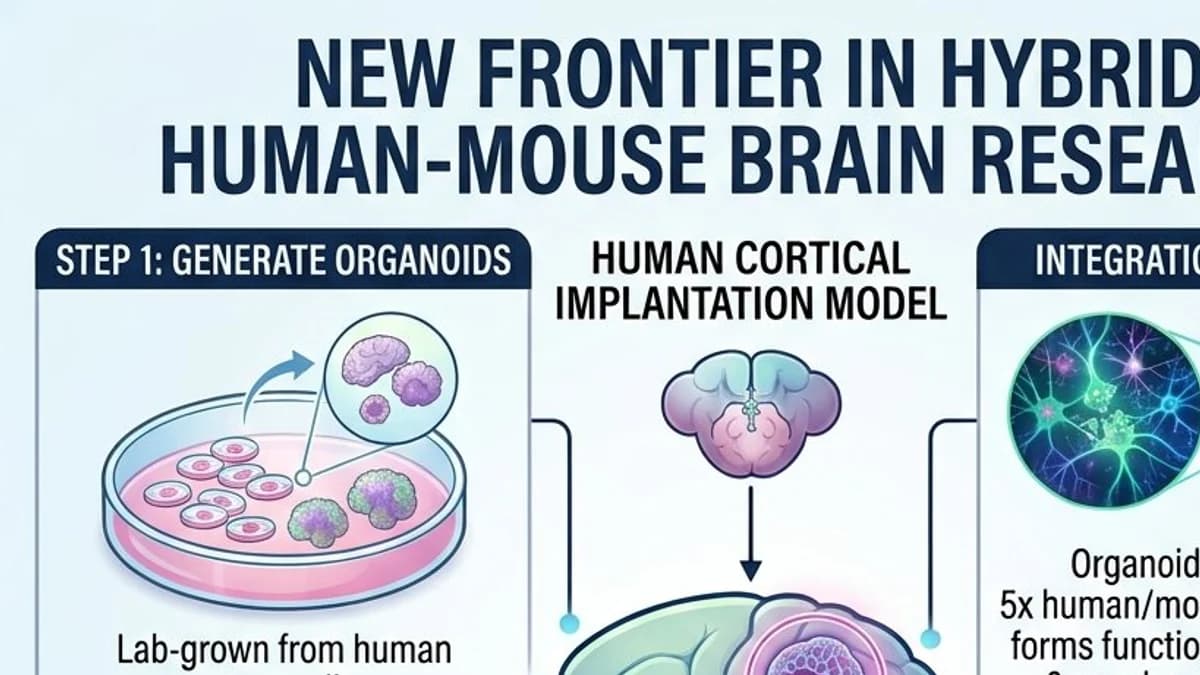
This study involved implanting small "growths" of human brain tissue into newborn mice in order to see how they would integrate themselves into the mouse's brain.
While the idea of a “hybrid human-mouse brain” may sound far-fetched, in reality the scientists did not grow a human brain inside of a mouse.
They did, however, successfully grow human neurons inside of mice brains.
Growing mini-human brain structures
For this experiment, scientists began by growing "human cortical organoids".
These structures are miniature models of the human brain that are cultured in a lab from human stem cells.
The point of this study was to create 3-D human brain tissue structures that would replicate some of the functions of a real human brain.
This process began when researchers implanted these human cortical organoids into mice brains that had been genetically engineered to have a mostly absent cerebral cortex.
This genetic engineering was done to give the human brain structures plenty of room to grow, and to prevent the human and mouse neurons from competing for resources.
The organoids were implanted into newborn mice brains when they were only about two to three days old.
At this age, the mouse brain is still very plastic and able to form new connections.
The human neurons grew...
After the human cortical organoids were implanted into the mice brains, the tissue did not just survive, it thrived.
The human neurons actually grew and formed connections with the mouse brain cells.
According to the study, the human brain structures had grown to almost five times their original size after just three months of being inside of a mouse brain.
The article also states that "functional blood vessels" formed and kept the tissue alive.
The human neurons also formed connections with other parts of the mouse brain.
The study mentions connections in the thalamus, and axons that lead to the spinal cord.
The neurons even formed a synchronized electrical signal, which shows that they were firing together and communicating with each other.
The human neurons that grew inside of the mice were maturing more fully than they would in a petri dish, and they formed more complex dendrites and synaptic connections.
A new way to study neurological, psychiatric diseases?
One of the most important implications of this study is the potential that it has in helping us understand mental illnesses.
The traditional way of studying mental illness in mice does not fully capture what is going on in a human brain that is experiencing that mental illness.
Conditions such as schizophrenia and autism are more complex than a single faulty neurotransmitter.
They involve multiple interacting systems that do not lend themselves to the kind of isolation that is required in a petri dish.
Organoids made from human cells allow us to study these disorders in ways that were previously impossible.
Researchers could, if given enough funding, begin taking skin cells from patients with schizophrenia and grow those cells into neurons.
By using these new techniques, researchers could begin to really understand how these problems arise.
Neurological diseases such as frontotemporal dementia could also be studied using this new model system.
This method could even be used to find drugs and gene therapies for these illnesses, because researchers could test their theories on human neurons before moving on to traditional animal models and then finally to human clinical trials.
Looking at brain injury
The researchers also used this new experiment to look at oxygen deprivation in the brain, also called "hypoxia".
Brain cells do not function properly when they do not have enough oxygen.
When the researchers made the mice brains experience hypoxia, they found that it caused problems with the human neurons that they had implanted.
By creating this model of injury, researchers can now begin better treating patients with brain damage as a result of hypoxia.
This research could also aid in finding better treatments for diseases such as cerebral palsy.
Another interesting result was the discovery of specialized neurons called von Economo neurons.
These neurons play roles in social behavior and higher reasoning, and they have fascinated researchers because of their prevalence in humans and higher primates.
Ethics are an issue, but there's no reason to panic
Many people will see this research and think that we are one step closer to creating a "human-mouse hybrid" that is conscious or has intelligence like our own.
In reality, while the idea of a human brain inside a mouse might be interesting, the truth is that we are still far away from creating such a thing.
Even if researchers did eventually create a "man in a mouse", it would have no practical application.
That being said, this is an issue that some people believe requires more ethical scrutiny.
As our ability to create human brain structures increases, researchers need to be aware of the implications of that power.
Although it is highly unlikely, researchers still need to be on the lookout for the possibility of a human-mouse hybrid that has qualities similar to human intelligence.
A big deal, but not as huge as you might think
Scientists have successfully combined two different biological systems to create a hybrid that has some of the properties of a human brain.
For researchers, this is a major accomplishment.
It bridges the gap between traditional animal models and traditional petri dish models.
It allows us to peer into the way the human brain develops and how it reacts to things such as disease or injury, and it could lead to treatments for some of our most devastating neurological diseases.
That being said, this is not as groundbreaking as some other uses of gene editing that have been seen recently.
The article is interesting, but the experiment performed did not create a "human brain in a mouse" or prove that the mice in the study had any sort of human qualities in terms of intelligence or thought processes.
If researchers continue to find ways to improve upon this kind of study, while keeping ethical issues in check, this type of research could prove to be a major step forward in the future of neuroscience.
Sources: BBC News; La Voz de Galicia; Stanford University research.