
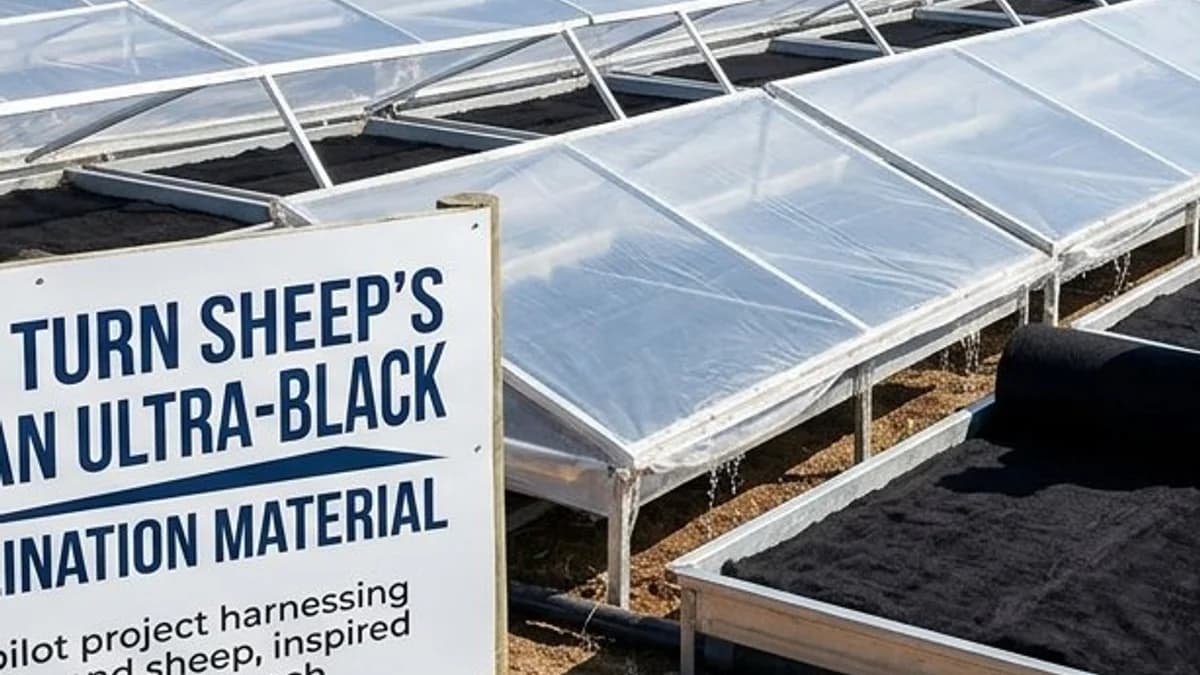
Could ordinary sheep's wool have an unexpected role in turning seawater into drinking water? Scientists have created an experimental solar desalination technology that uses modified wool to absorb sunlight
This technology falls within a class of experimental processes known as interfacial solar vapor generation (ISVG), which focuses energy at the boundary between water and air, where evaporation takes place. ISVG could potentially be more efficient than conventional solar distillation because it reduces the amount of energy wasted heating the bulk of the water.
How modified wool contributes to solar distillation
The authors of the study modified natural wool using a layer of polydopamine (PDA) adhesive, similar to what is found in mussels, and plasma etching to create tiny fibers, or nanofibrils. The combination of these two materials creates a surface that is extremely black, meaning that it absorbs nearly all of the sunlight hitting it rather than reflecting any of it back out.
According to the published results, the modified wool has a reflectance of approximately 0.13%. The absorbed sunlight is then converted into heat. At the same time, water molecules at the nanofibrils' surface are evaporated, leaving the salt behind. This vaporized fresh water can be captured for use or condensed back into liquid form.
A vertical orientation and mirrored light sources yielded 2.43 l/m²/h
The authors of the study tested several different configurations of the wool, and found that the most promising results came from a vertical orientation under mirrored light sources. According to the authors of the study, this method yielded an impressive 2.43 l/m²/h of evaporation when exposed to simulated sunlight.
The key finding here is that the shape of an ISVG device can have a major impact on its performance and, by extension, its value. For example, the researchers were able to demonstrate that a vertical surface can provide a larger surface area for light absorption than a horizontal sheet placed directly on top of the pool of water. The overall efficiency of the system will still depend on how much evaporation takes place and how much of that vapor can be captured and condensed back into liquid form.
Does it actually desalinate? Can we collect the water?
Salt accumulation presents one of the main engineering challenges of solar distillation systems. As water evaporates from a saltwater source, the salt becomes more and more concentrated. If the salt is allowed to accumulate on the evaporating surface, it can reduce the amount of light that reaches the water and act as a barrier to the flow of water molecules.
In the experiment, the researchers ran the system for 10 continuous hours without any significant salt accumulation in their test conditions. While this is a promising result, it is not definitive, since it does not reflect the potential for continuous accumulation in a real-world setting. The authors will need to conduct much longer experiments with actual seawater to see if the system can effectively resist salt buildup.
Does this technology require an external power source?
Solar distillation has some significant advantages over conventional methods like reverse osmosis, in that it can take advantage of abundant sunlight near coastal regions without the need for complex infrastructure. However, there are many situations where even a small amount of infrastructure can be a burden or unavailable. A portable, flexible distiller that uses part of its material from a readily available natural resource could have a number of useful applications.
Applications are still speculative at this point, since the system is still an experimental technology. In its current form, it is unlikely to have any immediate commercial applications. In the future, however, these could be very valuable.
Is it sustainable?
While wool is a natural, biodegradable substance, sustainability is not easily determined from that fact alone. A complete life cycle analysis would be needed to compare this technology's overall environmental impact to a similar system that uses conventional solar-absorbing materials.
The researchers would need to evaluate the environmental cost of the PDA coating, the energy required during the plasma etching process, and whether the material can be repaired or replaced easily when it reaches the end of its useful life.
The ultimate test: the real world
The system's performance was tested in an environment under controlled conditions and simulated sunlight, but how will it perform when exposed to the varying conditions of an outdoor environment?
Sunlight is much weaker on cloudy days and during the winter, and high winds can lower the temperature of the system. The presence of dust on the surface of the wool can reduce the amount of sunlight being absorbed. Seawater is filled with organic matter that can accumulate on surfaces, and the wool's natural properties may make it more susceptible to biological buildup.
Since wool is an organic material, its long-term exposure to a humid environment also needs to be evaluated. Researchers will need to investigate whether its surface properties change over time due to exposure to microorganisms or simply mechanical stress.
On the manufacturing side, scaling up the production of this material to create large enough sheets for practical use will be a challenge. Plasma etching is a precise but potentially time-consuming process, which means that new methods of manufacturing may need to be developed.
Where do we go from here?
Further experimentation will be needed to analyze the properties of this novel material on a much larger scale. Researchers will also need to gather data about the long-term performance of the system when exposed to seawater and outdoor conditions.
Most importantly, they will need to collect and analyze data about the quality of the produced water, salt buildup, and biological contamination. The overall cost and manufacturing practicality of such a system will be just as important to analyze.
At this point, the research represents a compelling but ultimately impractical concept.
Its value lies in its ability to combine easily accessible resources and familiar concepts into an innovative new approach. The system's overall performance is promising, but its continued development will require more research into its long-term viability in the field.
Sources & Further Reading
Cornell University — Original research report
Tech Xplore — Detailed coverage
EcoInventos — Spanish coverage
Cornell University College of Human Ecology