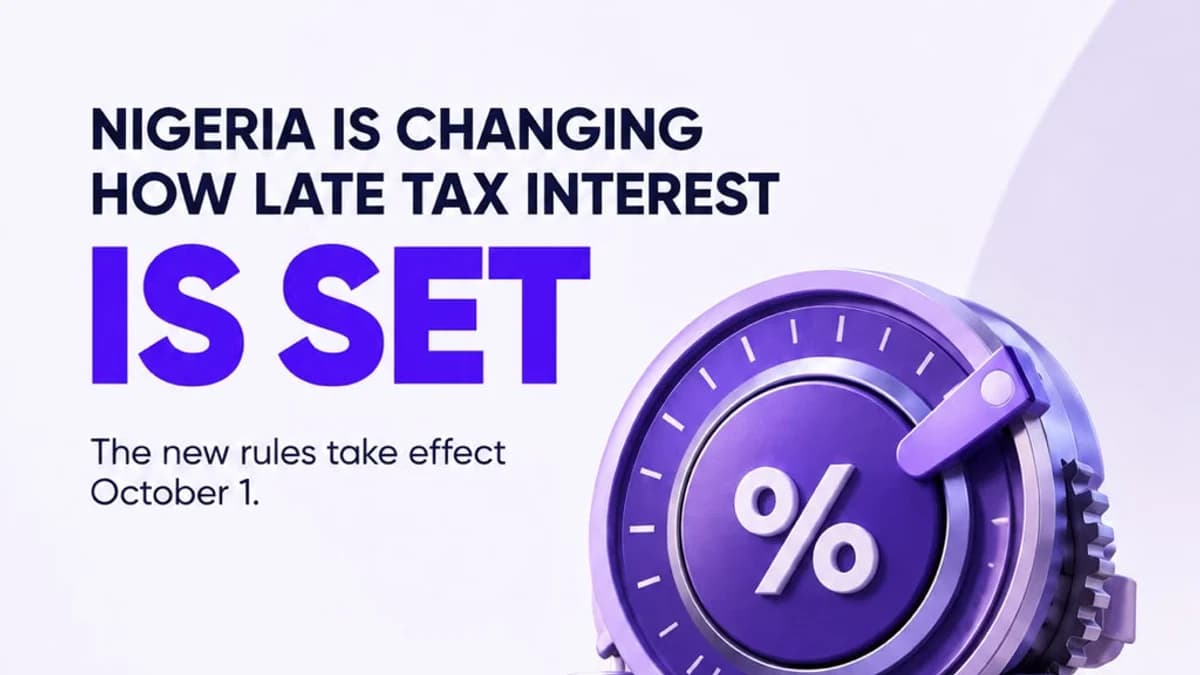
Paying your tax late is about to work a little differently.
From October 1, 2026, interest on late tax payments will be linked more closely to prevailing market rates under a new order issued by the Minister of Finance and Coordinating Minister of the Economy, Taiwo Oyedele.
The Nigeria Tax Administration (Interest on Late Payment of Tax) Order, 2026 was issued under Section 65 of the Nigeria Tax Administration Act, 2025. It replaces the previous interest structure and introduces a formula that can change as market conditions change.
The change affects how much interest can accumulate when a taxpayer does not pay an outstanding tax liability by its due date.
What is changing?
For tax payable in naira, the new order sets the late payment interest at the Central Bank of Nigeria’s Monetary Policy Rate plus one percentage point.
Previously, the applicable spread was five percentage points above the MPR.
The new rate also cannot fall below the yield on 364 day Treasury Bills. The government says this floor reflects the cost of government funding when taxes that are due are not paid on time.
This means the interest rate is no longer simply based on a fixed spread. It will move with the underlying market benchmarks.
For tax liabilities payable in foreign currency, the order provides for interest based on the Secured Overnight Financing Rate, or SOFR, plus six percentage points. If SOFR is discontinued, its officially designated successor rate will be used.
The rate will be published every month
One of the changes introduced by the order is a monthly rate publication system.
There will be one applicable interest rate for each calendar month. The Nigeria Revenue Service is required to publish the applicable rate on its website by the third business day of the month.
The rate for each month will be determined using the relevant benchmark from the last business day of the preceding month.
For taxpayers, this means the cost of late payment should be easier to establish before making a payment.
It also means the applicable rate can change from month to month as the underlying market rates change.
Interest will be calculated daily
The order also provides that interest will be calculated as simple interest on a daily basis.
The calculation starts from the date the tax becomes due and continues until the outstanding amount is paid.
For example, if a taxpayer has an outstanding tax liability and does not settle it when due, the amount of interest will depend on the applicable monthly rate and the number of days the tax remains unpaid.
This makes the timing of payment relevant. Leaving an outstanding tax liability unpaid does not mean the additional cost stays fixed.
The 10 percent late payment penalty has not disappeared
There is an important distinction to understand here.
The reduction in the interest spread does not remove the separate 10 percent penalty for late payment provided under Section 65 of the Nigeria Tax Administration Act, 2025.
In other words, a taxpayer who pays late may still have both the applicable interest and the statutory penalty to deal with, subject to the relevant provisions of the law.
The Act also gives the relevant tax authority the power under Section 66 to remit all or part of a penalty or interest where good cause is shown.
What happens to tax that was already due?
The new rules also have a transition point.
The government says the new rates will apply to interest arising from October 1, 2026, including interest on tax liabilities that became due before that date.
However, interest that had already arisen before October 1 will remain subject to the rules that applied when that interest arose, where those rules specifically provide for it.
So, the important date is not simply when the original tax liability arose.
The treatment of the interest depends on when that interest arises under the applicable rules.
Why is the government changing the formula?
The government says the new system is designed to make the cost of late payment more closely reflect market conditions.
The reasoning is straightforward. When tax that is already due is not paid, government does not receive the money when expected and may have to find other ways to fund its obligations.
Oyedele said the new framework is intended to prevent taxpayers from effectively treating unpaid tax as a cheaper source of credit than borrowing from the market.
The monthly publication of the rate is also intended to give taxpayers more certainty about the cost of delaying payment.
What does this mean for freelancers and small businesses?
For a freelancer or small business owner, the practical lesson is simple: tax liabilities should be tracked alongside the dates they become due.
If you have several clients, different income sources or tax obligations during the year, it can become difficult to keep track of what has been filed, what has been paid and what is still outstanding.
Good records can help you keep that picture clear.
For example, if you have a tax liability arising from your freelance income, you should be able to trace the income that created the liability, the return connected to it, the amount due and the date payment was required.
The same applies to businesses managing multiple tax obligations. Keeping payment confirmations, returns, assessments and other relevant records together makes it easier to identify outstanding liabilities before additional interest and penalties accumulate.
Late payment should not become an afterthought
The new order changes how late payment interest is calculated, but it does not change the basic responsibility to pay tax when it is due.
The interest rate will now be linked to market benchmarks, published monthly and calculated daily. The separate 10 percent late payment penalty also remains in place.
For taxpayers, that makes accurate record keeping even more useful.
Knowing how much tax you owe is one thing. Knowing when it became due, whether it has been paid and what documentation supports the payment is just as important.
The new framework takes effect on October 1, 2026. From then, the Nigeria Revenue Service will publish the applicable monthly rates under the new system.
For freelancers and businesses, keeping track of tax obligations throughout the year can make it easier to avoid unnecessary interest, penalties and last minute scrambling.
LessaTax helps freelancers organise their income, expenses, invoices, receipts and other financial records throughout the year, so their financial activity is easier to understand and reconcile when tax obligations come due.
Good tax records do more than help you file. They help you know what you owe, when it is due and whether it has been paid.