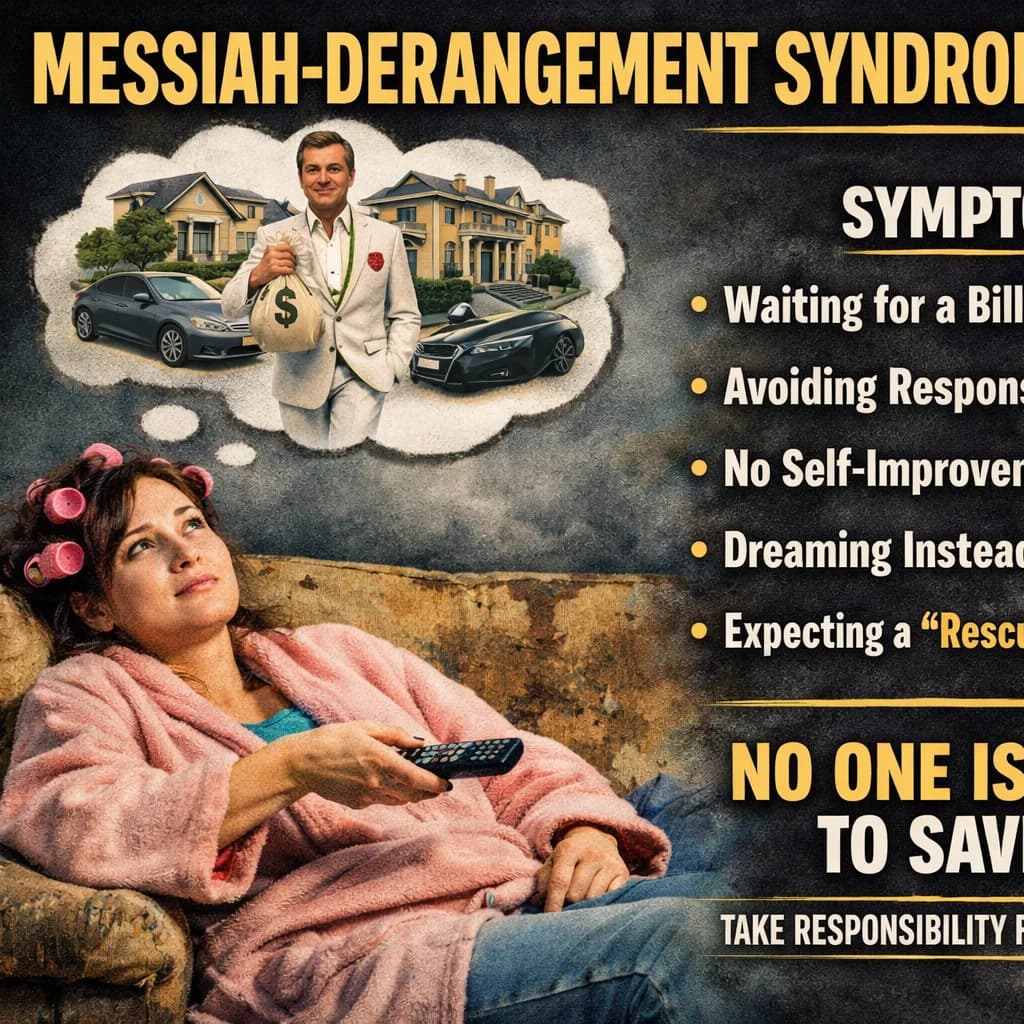
In every era of economic uncertainty, a new folk disorder emerges. Today, it looks like this: Messiah-Derangement Syndrome, or MDS. It is not in the DSM-5-TR, but you have seen it in your feed, your family group chat, maybe even your own mirror.
What is MDS?
MDS is a pattern of thought and behavior marked by the persistent belief that a single, larger-than-life figure — a “Messiah-billionaire” — will appear suddenly and reverse one’s financial fate. Sufferers are convinced that salvation is external, imminent, and unearned. They don’t budget, re-skill, or build. They wait. They scroll. They pray to the algorithm that Elon, Bezos, or the next tech demigod will notice them, fund them, or hire them into a seven-figure life.
The core symptom is abdication of agency. Responsibility gets outsourced to fantasy. Job loss becomes “the universe clearing space for my billionaire to find me.” Debt becomes “temporary, until my breakthrough.” The patient’s calendar is empty of action but full of expectation.
How it spreads:
MDS is contagious because modern media rewards spectacle over process. Viral stories of 20-year-olds selling startups for nine figures create the illusion that wealth is a lightning strike, not a craft. Social platforms amplify the outliers and mute the ten million people who improved their lives by learning Excel, showing up on time, and compounding small wins. The algorithm doesn’t monetize “I worked 6 years and paid off my loan.” It monetizes “A billionaire DM’d me and changed my life.”
The result is a kind of economic learned helplessness. Why apply to 50 jobs when you could spend that time perfecting a tweet that might go viral and catch a founder’s eye? Why learn a trade when you’re convinced Mr. Beast or Musk is about to run a “give $1M to a random follower” campaign? The odds are lottery-tier, but the dopamine hit of hope is free.
The real cost:
MDS doesn’t just delay progress — it inverts cause and effect. In reality, the people billionaires actually “save” tend to be the ones who were already building something. They had a project, a skill, a reputation. The billionaire was an accelerant, not a creator. MDS sufferers skip the building part and wait for the acceleration.
Time is the hidden tax. Five years spent waiting is five years not compounding skills, savings, or relationships. The world changes while the patient stands still, convinced stillness is strategy. By the time the fantasy fades, the gap between them and their peers is wider, which perversely reinforces the belief that “only a miracle can save me now.”
Treatment and remission:
There’s no pill for MDS, but the protocol is simple and unsexy. First, name the delusion: no one is coming. Not out of cruelty, but out of math — there are 8 billion people and a handful of messiah-billionaires. Second, replace passive hope with active bets you control. Learn a cash-flowing skill. Ship small projects. Save $20 before you wait for $20,000. Responsibility is the exposure therapy.
The goal isn’t to erase ambition or cynicism about luck. Luck exists. Windfalls happen. But people who recover from MDS understand the difference: luck favors the prepared, and messiahs invest in disciples who already started walking.
MDS thrives where agency dies. The cure is to take your life off pause and realize the person most qualified to save you has been here the whole time.
Olajide Ojeniyi.
Fellow, Youth Advisory Group.
World Bank-S4YE.