
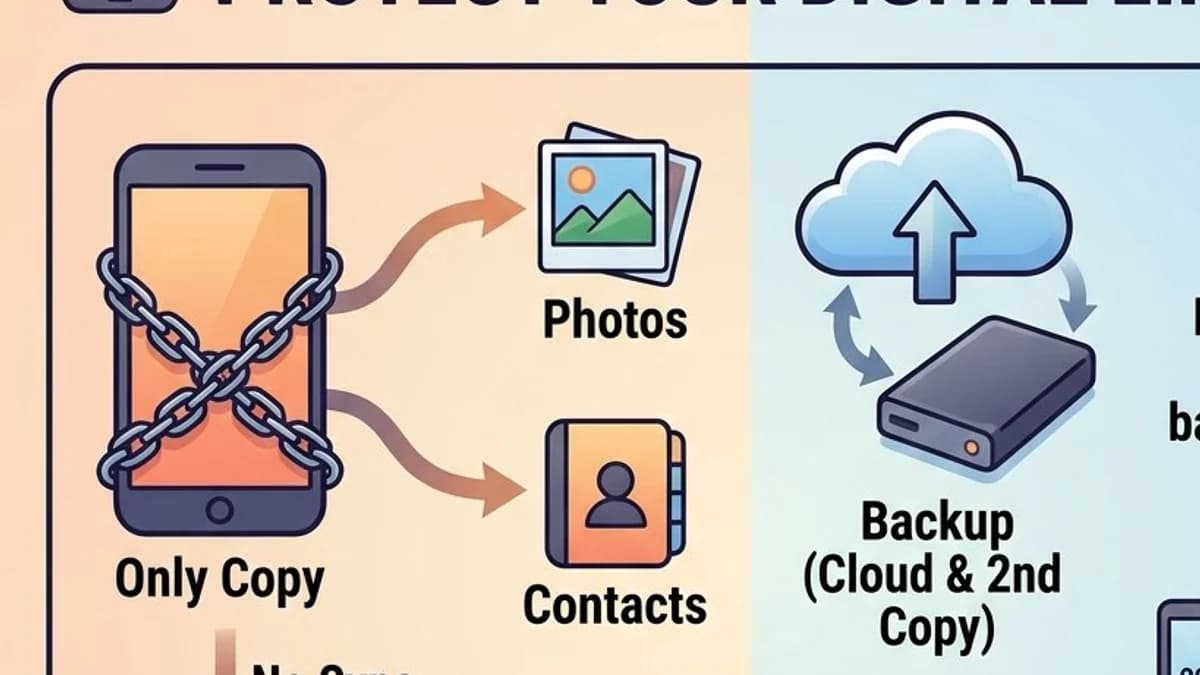
What would happen if you woke up tomorrow and your phone had vanished?
Maybe you left it in a taxi that just drove away. It could have been stolen at a bus stop. Perhaps it dropped into a lake and got crushed into a puddle of mush.
At first, you might tell yourself, "it's just my phone. I can buy a new one."
But then it hits you: all your contacts are in there. And then your photos. WhatsApp, email, social media, banking apps, documents, notes, photos, passwords... almost everything, and your whole life sits on that small device.
But what truly worries me is this:
If you lost your phone today, could you rebuild your digital life?
Your smartphone is the engine room of your digital existence
Today's smartphones are the command centers of our digital lives.
We rely on them for everything, from chatting with friends and family to banking, storing photos, working, studying, creating art, saving documents online, and much more. In a real sense, we put our lives onto these devices.
Since they hold such a wealth of information, it's natural to feel anxious when we lose them.
If your photos exist only on your phone and you lose it, you might never see those pictures again.
If you can't get into your phone but have another device handy, can you still reach your important accounts?
Perhaps you can't log into your email since it needs a verification code delivered by SMS to your phone number.
I'm not claiming the phone is always the problem,
What I'm saying is that the phone is a doorway into our digital life.
Your First Line of Defense: Backups
The simplest and most basic way to safeguard your digital life is through your backup.
Be sure your key photos, documents, and other digital information are stored in another copy somewhere else.
Cloud storage options can really save the day here. On some platforms, the files stored there get backed up to the cloud automatically.
You can also store a copy of key documents in another place, perhaps on a different device.
The key point here is this:
a single copy of your digital data does not count as a backup.
If that single copy sits on your phone and your phone gets lost, stolen, or smashed, then you've just lost everything.
Your Recovery Email Matters a Lot
Many of us make sure our important accounts have strong, unique passwords.
But do we have recovery details set up for them?
Your email account can be a priceless way to get back into many of your accounts.
Be sure you can access the email account you've set as your recovery information.
Also, if you have several email accounts, make sure they're linked to one another.
In an emergency, you don't want to discover that your recovery email no longer exists.
Safeguard Your Authentication Methods
Security features such as two-step verification play a huge role in keeping your accounts safe.
But if your phone is the only thing protecting your accounts, then misplacing it could cause more problems than it solves.
If you ever lose your phone, recovery codes can really save the day.
If you have recovery codes for your key accounts, don't keep them only on your phone.
Certain services also offer other ways to verify who you are besides your phone, such as a second trusted device, a security key, or another phone number.
The worst outcome here is that your own security ends up shutting you out of your accounts.
Your Contacts Are Worth Protecting Too
We tend to forget how valuable our contacts are.
If every number we know lives on our phone and that phone goes missing, we may lose access to all those numbers.
But you can avoid this easily by syncing your contacts to an account you trust.
That way, if you lose your phone and buy a new one, getting your contacts back is simple.
This matters because you likely have numbers you don't want to lose. Work numbers, family numbers, client numbers - you name it.
Don't Forget Your Photos and Documents!
Your camera roll might hold memories you treasure.
Your documents folder might hold files that matter.
Your messages might hold information you truly need.
Spend a moment thinking about what you would really hate to lose, then figure out how to back it up.
You don't have to build a complicated, multi-layered encryption setup to protect your data. Actually, a basic cloud backup plus an extra copy on another device would work far better.
What If Someone Took Your Phone?
A solid backup keeps your data safe, but what about the phone itself?
Be sure your phone has a strong screen lock. If your phone comes with a built-in find-my-phone app or remote wipe feature, make sure it's switched on in case the worst happens.
Also, be sure you know how to reach your cellular provider to cancel or suspend your SIM card whenever you need to.
Most importantly - don't wait until your phone is lost to do any of this.
Do a Self-Discovery Checkup Today!
Here's an easy challenge for you.
Spend fifteen minutes of your life and ask yourself
'if my phone vanished right now, what would I lose access to straight away?'. Once you've collected your thoughts, go through this checklist on your own:
- Are my important photos backed up?
- Are my contacts synced?
- Can I get back into my main email?
- Do I have recovery details for my main email?
- Have I stored my authentication recovery codes?
- Are my important documents saved on another device?
- Do I have a way to locate my phone if it's stolen?
- Can I recall the passwords for my important accounts?
If you answered 'no' to any of these questions, you now have a good reason to fix it.
Your digital life shouldn't rely so heavily on your phone
Smartphones are amazing devices that can hold our whole lives in one place.
They make life easier for us.
But sometimes easier is not better.
If you lose your phone, you shouldn't lose your photos, your memories, your family contacts, your documents, your accounts, and all the work you've done over the years.
You don't have to become a cybersecurity expert, start learning about encryption and password cracking, or buy a dozen safety tools.
But maybe start by backing up your photos and making sure your email is secure.
Maybe sync your contacts and make sure your documents are kept safe.
Maybe make sure you know how to find your device if it's stolen, and keep your passwords somewhere you can find them in an emergency.
In short,
don't wait until you lose your phone to learn how to protect it.