
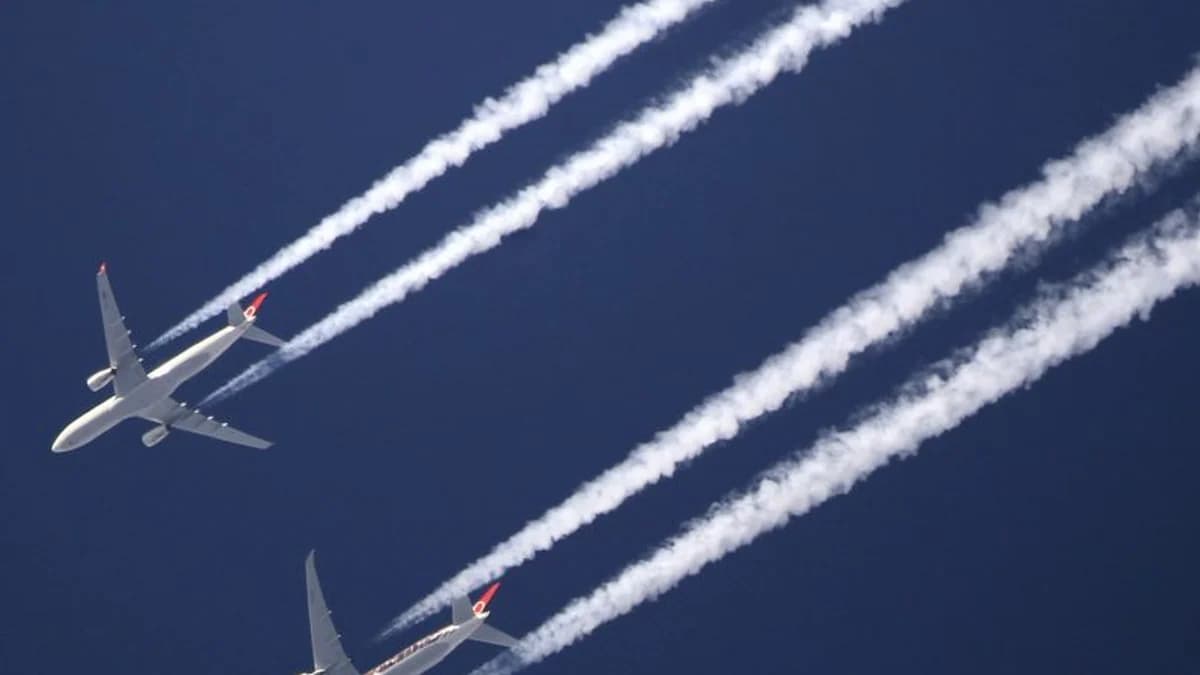
Artificial intelligence is set to confront yet another inconvenient truth of aviation: contrails. Those wispy lines left in the sky by high-flying planes can have a warming affect on the atmosphere, and some say that Google is going to prevent contrails using artificial intelligence.
Unlike some conspiracy theories, this one is grounded in reality. It turns out that contrails, those vapour trails that sometimes linger behind aircraft, may act like greenhouse gases and contribute to global warming.
Google's Operation Blue Skies
Google, working with the UK government and others, is developing a project called Operation Blue Skies that will use artificial intelligence to help keep planes out of the air on days best suited to avoid "persistent" contrails.
A combination of satellite imagery and weather forecasts plus past flight data are being fed into an AI system that helps predict where contrails are likely to form. That information can help air traffic controllers suggest alternative routes to avoid lingering contrails. The adjustments to flight paths should be small enough that passengers probably won't even notice.
AI Can Learn From Every Flight
The beauty of this operation is that the AI can keep learning from every flight path and adjusting future ones. So after planes have flown and contrails formed or not, satellite imagery and other information can be used to update the programme and improve its accuracy.
That means AI predicts likely contrail formation, planes adjust their flight path when possible, and then observers update the AI based on what actually happened. It's a self-learning system that should become more accurate the more it is used.
Testing Over The North Atlantic
The tests will take place in the Shanwick Oceanic area, which is in the eastern part of the transatlantic flight corridor. It has ideal conditions for testing since it has a high percentage of the kind of persistent contrails that warm the atmosphere.
Operation Blue Skies is expected to last 30 months with major testing planned for winter 2026-2027 and 2027-2028. There will be about 10,000 flights using this technology per year with only about 1 to 5 percent of them needing to be adjusted to avoid contrails.
Previous Tests Showed Promise
Google has already tested the technology with American Airlines and claims that the tests reduced contrails by 54 percent with only a 2 percent increase in fuelling for the adjusted flights.
The larger test with Operation Blue Skies will confirm if the technology can work at a bigger scale.
What This Means For Aviation And The Climate
If the tests are successful, it could be a huge step forward in efforts to curb the industry's contribution to greenhouse gas emissions. It might also be a huge step for the airline industry as well as passengers. After all, it would be a relatively inexpensive modification that could help protect the environment without having to make huge changes to current flight patterns
Maybe One Day It Will Work Anywhere
The ultimate test of such a technology would be if it could be applied worldwide. After all, AI technology could zero in on where a single contrail might form and suggest a flight change to avoid it. Operation Blue Skies, on the other hand, is looking to avoid areas where contrails are likely to form, not necessarily individual instances of them.
The technology still has to prove itself at a larger scale and reduce overall warming effects without using too much extra fuel and adding to costs and greenhouse gasses. But if it works, artificial intelligence could play a major role in curbing the climate-changing abilities of contrails.
Sources