
TRAIN UP A CHILD PARENTING PODCAST
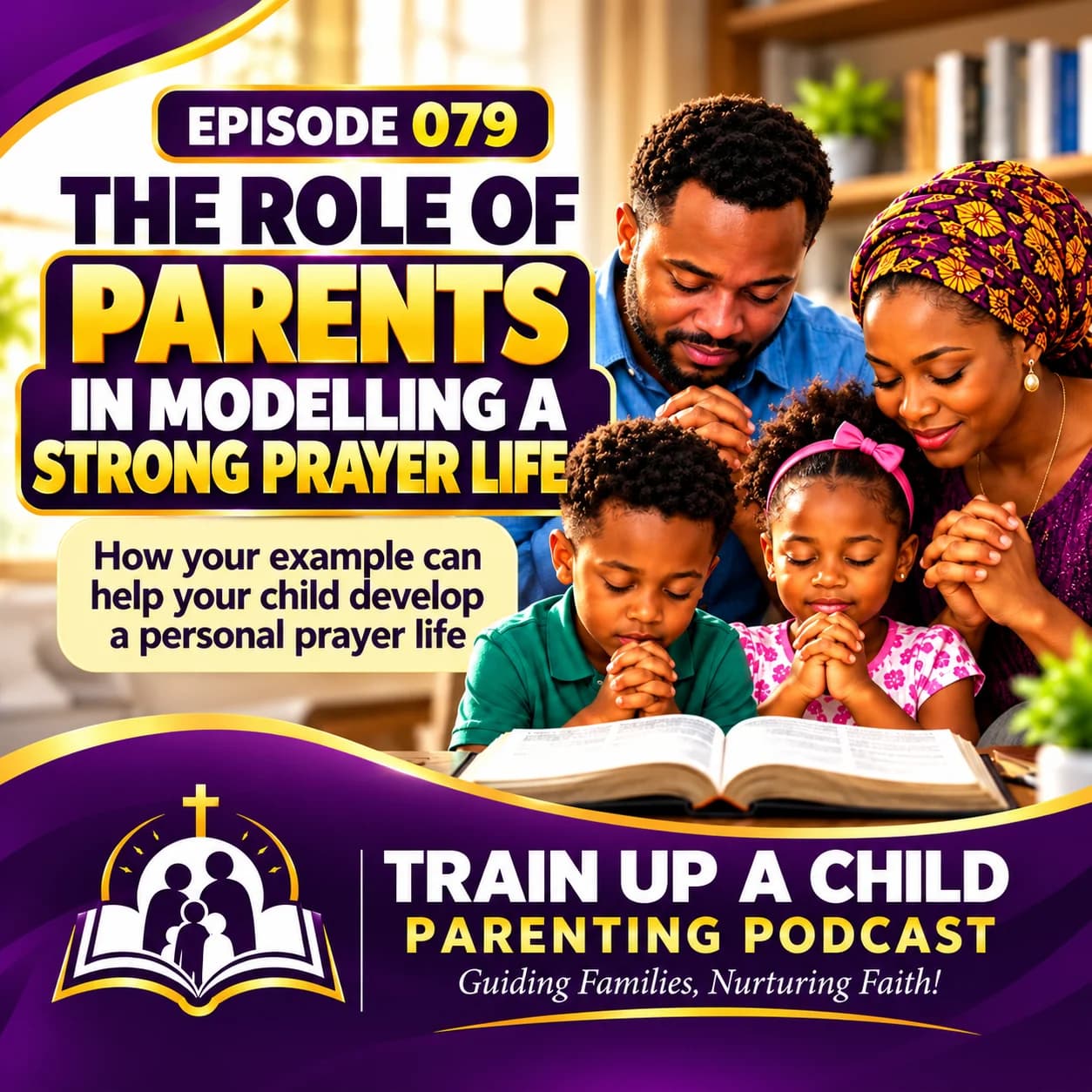
Episode 079: The Role of Parents in Modelling a Strong Prayer Life
Thursday | Day 4 | Week 12
THIS WEEK'S THEME: Helping Your Child Develop a Personal Prayer Life
Hello, dear parents!
Welcome to today's episode of the Train Up A Child Parenting Podcast. I am Pastor August, your daily parenting podcast host.
In our previous episodes, we explored the importance of teaching children to pray, how to teach them to talk to God sincerely, and how to encourage them to pray with faith and expectation.
Today, we will consider an important question: Are we teaching our children to pray only through our words, or are we also teaching them through our example?
Dear parents, children learn a great deal by observing the adults around them. They watch how we speak, how we respond to challenges, how we treat other people and how we practise the values we teach.
Yet, many parents and caregivers work long hours to provide for their families. They want to pay school fees, provide good food, maintain a secure home and prepare their children for the future.
However, the more time they spend pursuing income, the less time they may have to pray with their children, listen to their concerns and nurture their spiritual lives.
This can leave parents struggling to balance two important responsibilities: providing for their families and being present to raise their children.
Dear parents, what if you could explore a practical business model that may help you improve your financial position and work towards a better balance between providing for your family and spending meaningful time with them?
Please stay with me until the end of today's episode. I will share an opportunity you can examine for yourself.
Now, let us turn to today's lesson.
A strong prayer life is not built by telling children to pray while they rarely see us praying. It grows when our words and actions work together to demonstrate that prayer is an important part of our relationship with God.
TODAY'S OUTLINE
Today, we will explore what it means to model a strong prayer life, examine a guiding Scripture, identify practical ways parents can demonstrate prayer, discuss common mistakes to avoid, complete a family prayer activity, reflect on our personal example and pray together.
WHAT DOES IT MEAN TO MODEL A STRONG PRAYER LIFE?
Dear parents, modelling a strong prayer life means allowing our children to observe us practising prayer sincerely and consistently.
It means that prayer is not merely something we talk about during family devotion or church services. It becomes part of how we approach everyday life.
Our children can observe us thanking God for His goodness, seeking wisdom when we face difficult decisions, praying for people in need and turning to God during challenging seasons.
This does not mean parents must pretend to be perfect or pray publicly at every opportunity.
Rather, it means demonstrating an authentic relationship with God and helping our children understand why prayer matters to us.
When children see that we value prayer, they have an opportunity to learn that prayer is not simply a rule imposed on them. It is a meaningful part of Christian living.
GUIDING SCRIPTURE
Proverbs 22:6 teaches us to train up a child in the way he should go.
This principle reminds parents of their responsibility to guide children towards a way of life that reflects godly values.
Training involves more than giving instructions. It also involves demonstration, repetition, encouragement and correction.
If we want our children to develop a personal prayer life, we should make room for them to see prayer practised in our homes.
Jesus also provided an example of a life marked by prayer. The Gospels record occasions when He withdrew to pray and sought time alone with the Father.
His example reminds us that prayer deserves intentional attention.
Dear parents, we cannot force our children to develop a personal relationship with God. However, we can create a home environment in which prayer is demonstrated, encouraged and practised with sincerity.
FIVE WAYS PARENTS CAN MODEL A STRONG PRAYER LIFE
First, let your children see you praying.
Children should not hear about prayer only when you ask them to pray.
Let them occasionally observe you spending time in prayer. You might pray quietly in the morning, during a personal devotion or when seeking wisdom about a family matter.
You do not need to turn every private moment into a public demonstration. The aim is to let your children understand that prayer is a genuine part of your life.
When appropriate, explain why you pray.
For example, you might say, "I am taking some time to pray because I need God's wisdom as I make this decision."
This helps your child understand that prayer is not limited to emergencies or church activities.
Second, pray with your children consistently.
Make family prayer a practical part of your routine.
You might pray together before school, at mealtimes, during family devotion or before bedtime.
Choose a time that works for your household.
If your schedule is demanding, begin with a few focused minutes rather than setting an unrealistic routine that is difficult to maintain.
Invite your children to participate. Let them take turns praying, expressing gratitude or mentioning people they would like the family to remember in prayer.
Consistency can help prayer become a familiar and meaningful part of family life.
Third, demonstrate prayer during difficult situations.
Children notice how adults respond when things go wrong.
When you face disappointment, uncertainty or a difficult decision, show your children that you can seek God's wisdom while also taking responsible action.
For example, if a family plan changes unexpectedly, you might explain that you are praying for patience and wisdom as you decide what to do next.
Avoid using prayer to frighten children or suggesting that every difficulty is punishment from God.
Instead, demonstrate calmness, honesty, faith and practical problem-solving.
Your example can help children understand that prayer is a source of spiritual strength, not a guarantee that life will always be easy.
Fourth, let your prayers reflect gratitude and compassion.
A strong prayer life is not only about asking God for personal needs.
Let your children hear you thanking God for everyday blessings and praying for other people.
You might pray for a sick neighbour, a relative experiencing difficulties, a teacher, or someone who needs encouragement.
You can also encourage your children to identify people they would like the family to pray for.
This teaches them to look beyond themselves and recognise the needs of others.
Prayer can become an opportunity to nurture gratitude, kindness and compassion.
Fifth, let your behaviour agree with your prayers.
Dear parents, this is particularly important.
If we pray for our children to become patient but regularly respond to them with uncontrolled anger, they may struggle to understand the lesson we are teaching.
If we pray for honesty but frequently make excuses for our own dishonesty, our example may contradict our words.
If we pray for forgiveness but refuse to apologise when we are wrong, our children may find it difficult to understand what forgiveness means in practice.
No parent is perfect. We all have areas in which we need to grow.
When you make a mistake, acknowledge it. Apologise when necessary. Ask God for help and demonstrate how to make things right.
A sincere prayer life should influence how we treat the people around us.
Our children need to see that prayer and godly character belong together.
COMMON MISTAKES PARENTS SHOULD AVOID
Dear parents, as we model prayer, let us be careful not to turn it into a source of fear, pressure or competition.
Do not shame a child because their prayer is short or because they struggle to express themselves.
Do not compare one child's prayer life with that of another child.
Do not teach children that every difficulty will disappear if they pray correctly.
Do not make prayer a substitute for listening, taking responsibility or seeking appropriate help.
Most importantly, do not pretend to have all the answers.
When children ask difficult questions about prayer, listen patiently and respond honestly. If you do not know the answer, you can learn together through Scripture and seek guidance from a trusted spiritual leader.
The goal is to help children develop sincere faith, not merely to teach them how to perform religious activities.
ACTIVITY: OUR FAMILY PRAYER ROUTINE
Dear parents, here is a simple activity you can begin today.
Sit with your children and agree on one realistic time when the family can pray together regularly.
It could be before school, during an evening devotion or before bedtime.
Then agree on a simple five-minute routine.
Begin with gratitude. Invite each family member to mention one thing they are thankful for.
Read a short Bible passage suitable for your children's ages.
Allow each person to mention one concern or someone they would like the family to pray for.
Pray together in simple, sincere words.
Finally, agree on one practical way to demonstrate love or kindness during the day.
For example, the family might decide to help a neighbour, encourage someone who is discouraged or resolve a disagreement peacefully.
Try this routine for seven days.
At the end of the week, discuss what worked well and whether you need to adjust the timing or length.
Remember, the purpose is not to create a complicated programme. It is to build a consistent family habit that helps your children see prayer modelled in everyday life.
REFLECTION TIME FOR PARENTS
Dear parents, let us take a moment to reflect.
Do my children see me praying, or do they only hear me telling them to pray?
Have I made family prayer a realistic and consistent part of our routine?
Do my actions reflect the values I express in my prayers?
When I make mistakes, am I willing to acknowledge them and seek forgiveness?
What one change can I make this week to model a more sincere and consistent prayer life?
Remember, children learn from both our instructions and our example.
We do not need to be perfect parents. We need to be willing to grow and to demonstrate the values we want our children to learn.
LET US PRAY
Heavenly Father, thank You for the privilege of raising our children.
Please help us to develop sincere and consistent prayer lives. Teach us to seek Your wisdom, express gratitude and trust You through the different seasons of life.
Help us to become good examples to our children. Let our words and actions agree, and give us the humility to acknowledge our mistakes and make things right when necessary.
Give busy parents wisdom to manage their responsibilities and make meaningful time for their children's spiritual development.
Help our children learn to pray sincerely, grow in faith and develop godly character as they observe our example.
May our homes become places where prayer is practised with love, humility and understanding.
In Jesus Name, we pray. Amen.
LOOKING AHEAD
Tomorrow, in Episode 080, we will explore "Making Family Prayer a Meaningful Daily Practice."
We will discuss practical ways to make family prayer consistent, engaging and meaningful, even when parents and children have demanding schedules.
Please join us for the next episode.
CLOSING BLESSING
May God grant you wisdom, patience and grace as you guide your children.
May your children see in your life an example of sincere prayer, genuine faith, gratitude and love.
May your home become an environment where children are encouraged to seek God, ask questions, grow in wisdom and practise the values they learn.
Remember, dear parent, one of the most powerful ways to teach your children to pray is to let them see you making prayer a meaningful part of your own life.
FOLLOW US AND STAY CONNECTED
Dear parents, thank you for listening to the Train Up A Child Parenting Podcast.
To continue learning with us, follow Train Up A Child Parenting Podcast on these platforms.
Feedcover: https://feedcover.com/iwilltrainupachild
We look forward to growing with you as we continue guiding families and nurturing faith.
Train Up A Child Parenting Podcast — Guiding Families, Nurturing Faith!
A PRACTICAL OPPORTUNITY FOR PARENTS
Dear parent, throughout this episode, we have discussed the importance of being present and setting a good example for our children.
Yet, many families face financial pressures that make it difficult to balance earning a living with spending meaningful time together.
That is why I want to invite you to give me just 20 minutes to explore a business-model presentation.
It introduces an approach you may wish to consider as you assess possible ways to improve your family's financial position and work towards a better balance between providing for your loved ones and being present with them.
Give me just 20 minutes!
Watch the presentation here:
Take time to understand the model, ask questions, consider any costs and risks, and decide whether it is suitable for your circumstances. No business model can guarantee income or financial freedom.
Our goal is to build stronger family foundations while remaining intentional about raising our children in faith, wisdom and love.
Thank you for listening. I am Pastor August, reminding you to train up a child with wisdom, faith and love.
Train Up A Child Parenting Podcast — Guiding Families, Nurturing Faith!