
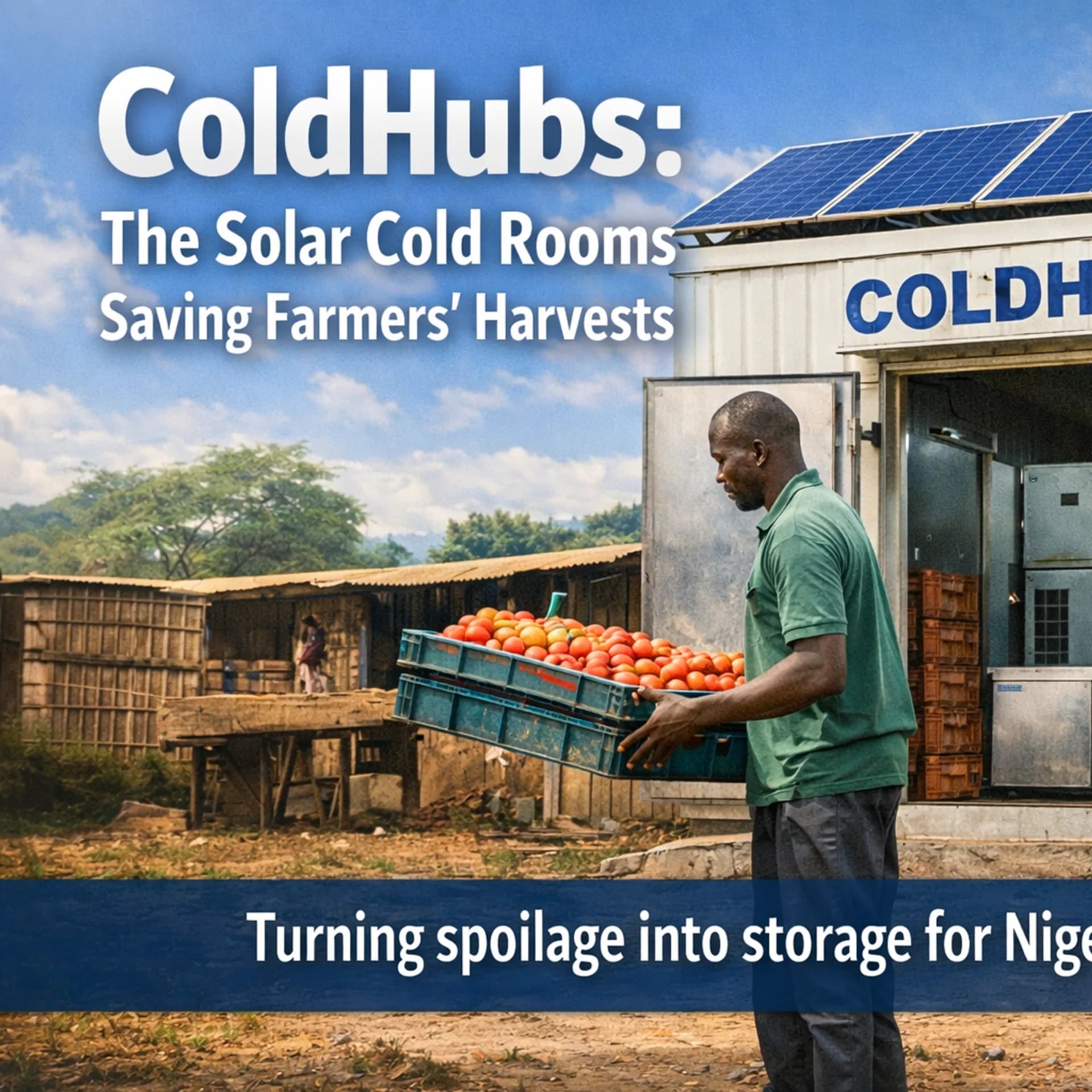
If you stand inside most open markets in Nigeria long enough, you’ll watch the same economic tragedy repeat itself in real time: a farmer arrives with produce that has a clock on it. The clock is not a date on a calendar; it’s heat, transport delay, and the time between “fresh enough to sell at a premium” and “sell at any price or lose everything.” When you don’t have cold storage, you don’t just lose food. You lose negotiating power. You lose the ability to wait for a better buyer. You lose the ability to split sales across days. You lose profit.
ColdHubs is built around a simple but unusually Africa-native insight: you don’t need every farmer to own a fridge. You need the market itself to become a shared cold-storage service — one that behaves like a stall you rent, not an asset you buy.
Nnaemeka Ikegwuonu, the founder, positions ColdHubs as solar-powered cold storage that reduces spoilage and supports smallholders.  But the deeper story is that ColdHubs is really a “micro-utility for freshness” — a recurring infrastructure service in a place where infrastructure is usually absent or too expensive to own individually.
The hidden builder advantage: the market is the distribution channel
Most startups think distribution is ads, agents, or partnerships. ColdHubs uses the market as distribution. Markets already aggregate supply (farmers) and demand (traders, retailers, processors). They are the natural choke point of the perishables economy. If you place a solar cold room near the point where produce changes hands, you’re not building a product; you’re installing leverage.
In that model, you’re not trying to convince a farmer to change their identity (“become a cold-chain operator”). You’re offering a small decision: store your tomatoes for a day or two; pay a fee; reduce loss; sell later at a better price. The adoption hurdle is low because the action feels like renting a space, not buying a machine.
The unit economics story most people miss
Cold storage usually fails in emerging markets because the economics are inverted:
• Ownership is expensive (capex)
• Power is unreliable (opex risk)
• Maintenance is specialist-driven (downtime)
• Utilization is inconsistent (seasonality)
ColdHubs flips this by bundling the hardest parts (power + maintenance + security) and charging per use. The business becomes viable if three conditions hold:
1. high utilization (markets give you this),
2. predictable payments (daily rental-like behavior),
3. low marginal cost of additional users once the hub exists.
What looks like “cold rooms” is actually a service business with infrastructure moats. Once a hub is planted in a market, competitors don’t just compete on price; they compete against presence, trust, and habit.
The behavior change that matters: time becomes an asset
In markets without cold storage, the farmer is forced into the worst bargaining posture: urgency. Urgency means discounts. Discounting becomes normalized. And that normalization shapes the whole value chain: traders expect cheap prices near the end of the day; farmers accept that loss is part of farming.
ColdHubs’ real impact is turning time into an asset. When you can store, you can:
• sell in batches,
• choose buyers,
• reduce distress selling,
• coordinate transport better,
• wait for the “right” day (or the right price).
That time advantage is subtle, but it changes the power dynamic.
Why this story fits DoingInsight’s “unseen builders” angle
People celebrate flashy fintech apps. ColdHubs is not glamorous, but it is foundational: it quietly upgrades the profit model of agriculture without asking farmers to become techies. It’s a builder’s builder story — someone solving the “boring” constraint that blocks real economic mobility.