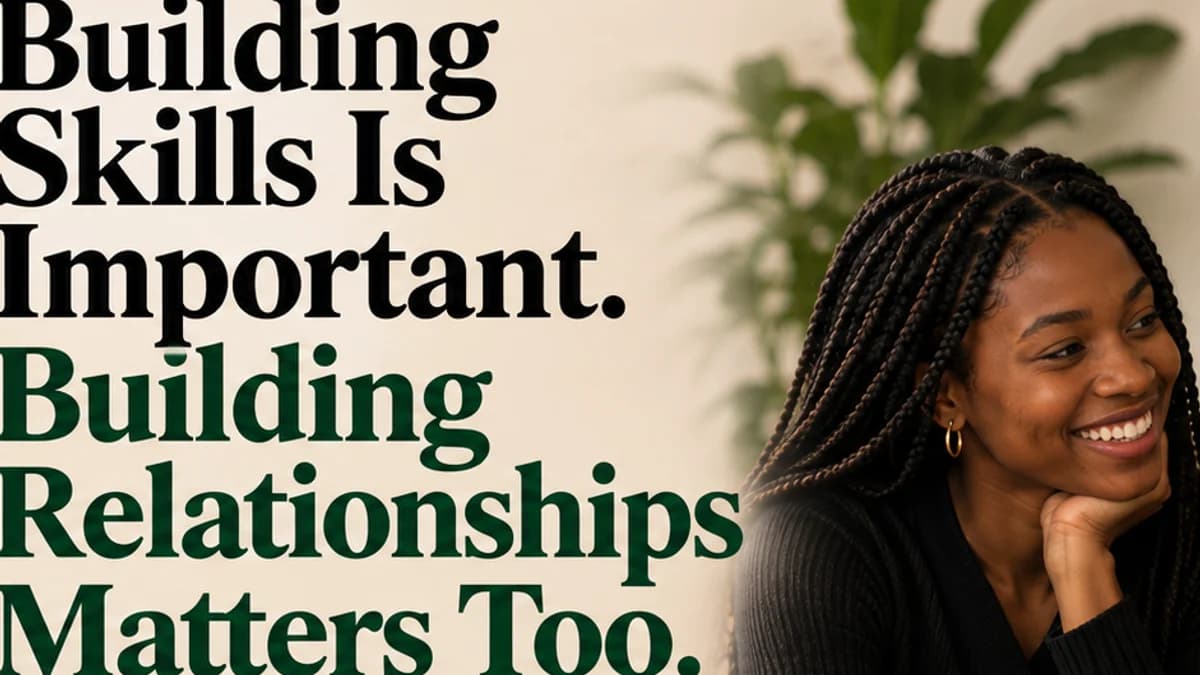
You can become incredibly good at what you do, but opportunities often move through people, conversations, trust, and connection.
For a long time, I believed that if I kept improving my skills, everything else would eventually fall into place.
Become a better writer.
Learn how to communicate better.
Understand strategy.
Improve my research.
Study marketing.
Learn how businesses work.
Get better at creating content.
Build a stronger portfolio.
Keep learning.
Keep improving.
And eventually, the opportunities would come.
There is nothing wrong with this mindset.
Skills matter.
In fact, skills are one of the strongest foundations you can build for yourself.
But over time, I started noticing something else.
Some of the most important opportunities do not come simply because someone is talented.
They come because someone knows them.
Someone remembers their work.
Someone trusts them.
Someone has had a conversation with them.
Someone recommended them in a room they were not in.
Someone saw their name repeatedly and eventually thought, I should speak to this person.
That changed the way I started thinking about growth.
Because building your skills is important.
But building relationships matters too.
Being good at what you do is only part of the equation
You can be an excellent writer and still struggle to find clients.
You can be a brilliant designer and still struggle to get referrals.
You can be a smart founder and still struggle to find the right partnerships.
You can create amazing content and still feel like you are speaking into an empty room.
Sometimes the problem is not your ability.
Sometimes the problem is that too few people know you well enough to think of you when an opportunity appears.
That is why relationships matter.
Someone might know three writers.
They may not choose the most talented one.
They may choose the person whose work they understand.
The person they have spoken to before.
The person they trust to communicate well.
The person who consistently contributes useful ideas.
The person who has built enough familiarity that reaching out feels natural.
This happens everywhere.
Jobs.
Freelance projects.
Speaking opportunities.
Collaborations.
Partnerships.
Referrals.
Introductions.
Business deals.
Communities.
The opportunity may look like it came suddenly, but very often, there was a relationship quietly developing behind it.
I have learned that visibility feels different when people actually know you
There is a difference between being seen and being known.
Someone can scroll past your content every week without really knowing who you are.
But when you consistently show up, respond to people, have conversations, share useful ideas and genuinely take an interest in other people's work, something starts changing.
You become familiar.
And familiarity matters.
People begin to understand what you do.
They understand how you think.
They know the kind of problems you solve.
They know the type of work you care about.
Eventually, your name becomes connected to something specific in their mind.
That is valuable.
Because opportunities are often triggered by association.
Someone hears:
“We need help with our content strategy.”
And your name comes to mind.
Someone says:
“We need a writer who understands B2B technology.”
And somebody remembers you.
A founder says:
“I need someone who can turn this complicated idea into something customers can actually understand.”
And a person in their network thinks of you.
You cannot always predict where those opportunities will come from.
But relationships increase the number of rooms your name can enter.
Networking does not have to feel forced
I think the word networking has become uncomfortable for many people because it often sounds transactional.
You imagine attending events and introducing yourself to dozens of strangers.
You imagine sending awkward messages like:
“Hello, I noticed we are both in the same industry. Can we connect?”
Or immediately asking someone for a job, a referral or an introduction.
That is not the only way to build relationships.
Real relationship building can be much simpler.
You can start by paying attention.
Read someone's work.
Respond thoughtfully.
Share something useful.
Congratulate them when they achieve something.
Ask a genuine question.
Offer an interesting perspective.
Introduce two people who could benefit from knowing each other.
Support someone's project when it genuinely interests you.
Have conversations without immediately wondering what you can get from them.
That is how many strong professional relationships begin.
Slowly.
Naturally.
Without pressure.
Stop treating every conversation like a transaction
One lesson I keep returning to is this:
Not every conversation has to produce something immediately.
That can be difficult when you are trying to grow your career or business.
You want results.
Clients.
Income.
Opportunities.
Connections.
So it becomes tempting to evaluate every interaction by asking:
“What can this person do for me?”
But relationships rarely work well when they are built that way.
Sometimes the person you meet today will never hire you.
But they may recommend you next year.
Sometimes someone cannot afford your service.
But they may introduce you to someone who can.
Sometimes a conversation leads nowhere professionally but gives you an idea that changes your work.
Sometimes the relationship itself becomes valuable long before any opportunity appears.
And sometimes nothing happens at all.
That is okay too.
Healthy relationships are not invoices waiting to happen.
Your relationships can amplify your skills
Imagine two people with similar skills.
Both are talented.
Both are reliable.
Both produce strong work.
But one person works completely alone.
They rarely interact with others.
They rarely share what they know.
They rarely maintain relationships.
The second person consistently participates in conversations.
They help others.
They publish their ideas.
They collaborate.
They stay connected with previous clients.
They build relationships with people across their industry.
Over time, those two careers can look very different.
Not necessarily because the second person is more talented.
But because their work travels further.
People talk about them.
Recommend them.
Invite them into opportunities.
Send opportunities their way.
Skills make you capable.
Relationships help your capabilities travel.
You need both.
The internet makes this easier than it used to be
One thing I genuinely appreciate about building online is the ability to form relationships with people you might never meet otherwise.
Someone can discover your work on LinkedIn.
Another person might read your article on Medium.
Someone else could find you through a newsletter.
You might meet another creator through a community.
A founder could discover your work because somebody shared it.
A writer on the other side of the world could become a collaborator.
You do not always need a formal networking event.
Sometimes it starts with a comment.
A reply.
A shared idea.
A direct message.
A conversation under a post.
The internet has reduced the distance between people.
But you still have to participate.
You cannot build meaningful professional relationships while staying permanently invisible.
Do not only appear when you need something
This is one of the easiest mistakes to make.
Someone disappears for months.
Then suddenly they message:
“Hi, I am currently looking for opportunities. Please let me know if you know anyone hiring.”
There is nothing wrong with asking for help.
But relationships become stronger when communication is not limited to moments when you need something.
Stay connected.
Check in occasionally.
Share something that reminded you of them.
Celebrate their wins.
Engage with their ideas.
Ask how a project turned out.
Maintain the relationship before you need the relationship.
That small habit can make a huge difference.
Your reputation is also being built through relationships
People remember how interacting with you feels.
They remember whether you responded.
Whether you listened.
Whether you delivered what you promised.
Whether you respected their time.
Whether you communicated clearly.
Whether you made working together easy.
Your skill may open the door.
But your behaviour determines whether people want to open another door for you later.
This is especially important for freelancers, consultants and independent professionals.
A great project can lead to several future opportunities if the relationship is handled well.
One satisfied client may return.
They may recommend you.
They may move to another company and hire you again.
They may mention you to someone in their network.
That is how a single relationship can quietly compound.
Communities can become powerful career ecosystems
I have also been thinking more about the importance of community.
There is something different about trying to grow alongside people who are also building something.
Writers.
Creators.
Founders.
Freelancers.
Professionals.
Business owners.
People trying to become better at their work while figuring things out in real time.
When those people gather in the right environment, interesting things can happen.
Someone shares a tool you did not know existed.
Someone explains something you were struggling with.
Someone gives feedback on your idea.
Someone introduces you to an opportunity.
Someone's progress motivates you to keep going.
You learn from people who are only a few steps ahead of you.
You help someone who is a few steps behind.
That exchange matters.
Growth becomes less isolating.
You do not need hundreds of relationships
I also do not think relationship building means trying to know everyone.
You do not need 10,000 close professional relationships.
That would be impossible.
What matters is developing meaningful connections with the right people.
A few people who genuinely understand what you do can be more valuable than thousands of random connections.
The goal is not collecting contacts.
The goal is creating trust.
And trust takes time.
That is why relationship building works better when you stop treating it like a numbers game.
Share what you know while you are still learning
You also do not have to wait until you become an expert before participating.
You can share what you are learning.
Talk about what you are testing.
Explain something you recently discovered.
Share lessons from mistakes.
Ask thoughtful questions.
Contribute your perspective.
This is especially powerful for people building careers online.
Because the more you share useful ideas, the easier it becomes for the right people to understand what you care about.
Your content becomes a conversation starter.
And those conversations can become relationships.
Those relationships can become opportunities.
Help people remember what you do
One thing many talented people underestimate is repetition.
You may feel like you have already explained what you do many times.
But most people are not watching everything you post.
They are busy.
They have their own lives.
Their own work.
Their own problems.
So talk about your work.
Share your thinking.
Show examples.
Explain the problems you solve.
Write about your industry.
Talk about the lessons you are learning.
Do it consistently enough that people start associating your name with your expertise.
You are not bothering people.
You are giving them context.
And context helps people know when to think of you.
Relationships should never replace competence
There is another side to this conversation that matters.
Relationships are powerful, but relationships cannot permanently compensate for poor work.
If someone recommends you, you still need to deliver.
If someone introduces you to a client, you still need to communicate professionally.
If your network creates an opportunity, your skills still have to support you once the opportunity arrives.
That is why this is not about choosing between skills and relationships.
It is about building both.
Become excellent at what you do.
Then make sure people know that you do it.
Improve your craft.
Then participate in the conversations happening around your craft.
Learn.
Create.
Connect.
Contribute.
Deliver.
Repeat.
Sometimes your next opportunity is already one relationship away
This is something I think about often.
You may be trying to figure out how to reach the next stage of your career.
Maybe you need a client.
A collaborator.
A mentor.
A business partner.
A job.
An introduction.
A new audience.
You may assume the answer is learning another skill.
Taking another course.
Getting another certificate.
Improving another tool.
Sometimes that is exactly what you need.
But sometimes you already have enough skill to move forward.
What is missing is connection.
Someone needs to know you exist.
Someone needs to understand the value you provide.
Someone needs to trust you enough to say your name in the right conversation.
That is why relationships matter.
Build the skill. Build the reputation. Build the relationships.
Keep learning.
Keep improving.
Take your craft seriously.
Become someone whose work speaks for itself.
But while you are doing that, do not disappear into your work so deeply that nobody knows you.
Talk to people.
Join communities.
Support good work.
Share what you know.
Stay curious about what other people are building.
Contribute before you need something.
Follow up.
Stay connected.
Because some opportunities come from applications.
Some come from content.
Some come from search engines.
And some begin with a simple sentence:
“I know someone who could help with this.”
You want to become the person someone remembers when that sentence needs to be said.
Your skills make you valuable.
Your relationships help that value reach the right people.
You need both.
Want to grow around people who are building too?
I created The Growth Room for writers, creators, founders and professionals who want to create better content, build authority, grow their visibility, strengthen their skills and turn their ideas into real opportunities.
It is a space for learning, sharing, connecting and growing alongside people who understand what it feels like to build something of your own.
If that sounds like the kind of community you have been looking for, you can join us here: