They were married in the dry season, when the harmattan blew fine red dust across the compound and the fires burned long into the night. The celebration was magnificent. Drums shook the ground. Women ululated until their throats were raw. Even Chief Obieze wept — though whether from joy or from something that had no name, he could not say.
When the guests had gone and the compound had quieted and the last fire had sunk to embers, Ikenna led Nneka to the inner room.
It was then that he brought out the necklace.
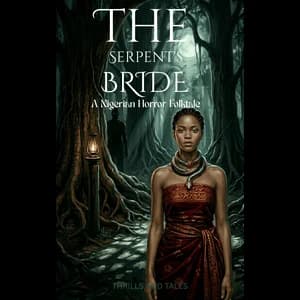
He drew it from a small goatskin pouch that he kept close to his body, and when he opened his palm, Nneka gasped. It was the most extraordinary thing she had ever seen. The necklace was fashioned of a deep, iridescent metal she could not name — not bronze, not copper, not gold, but something in between all three that shifted colour depending on the angle of the lamp's light. It was shaped like a serpent: long and sinuous, the body made of interlocking scales so finely wrought that they moved like living skin when touched. The head of the serpent was at the clasp, its mouth open in a silent, jewelled scream, and its eyes were set with two tiny red stones that glittered like coals.
"It has been in my family for many generations," Ikenna murmured, fastening it around her neck. "The women of my line all wear it. It is a symbol of protection." He placed a long finger beneath her chin and tilted her face up to look at him. "You are mine now, Nneka. And what is mine, I protect."
She felt the necklace settle cold against her collarbone.
And then — she felt it move.
****
She pulled back with a shriek, her hands flying to her throat. But Ikenna caught her wrists gently, laughing softly.
"It is only the warmth of your skin adjusting to the metal," he said. "All our women feel it at first. It will pass."
It did not pass.
****
Ikenna was, by every visible measure, a good husband. He was generous with money. He rebuilt Chief Obieze's compound. He brought gifts for Nneka regularly — fabric, oils, beaded anklets. He spoke to her with a tenderness that made the other wives in the village sigh with envy.
But there were things that gathered, quietly, like clouds that one does not notice until the sky has gone entirely dark.
Ikenna had no family who came to visit. He never went to the market. He could not be found at the evening palm wine gatherings where the men of the village sat and argued about farming and politics and the price of yams. He slept lightly — dangerously lightly — and twice Nneka had woken to find his side of the mat cold and empty in the deep of the night, only for him to be there again by morning, smelling faintly of damp earth and something else she could not name.
When she asked him about his family, he changed the subject so smoothly she did not always notice. When she asked about his village, he smiled and said, "When the time is right, I will take you there." The time was never right.
And the necklace.
Every day without fail, Nneka felt it: that slow coiling sensation. Some days it was gentle, almost like a caress. Other days it was tighter, insistent, and she would find herself gripping the edge of a table or the doorframe, her breathing shallow, waiting for it to ease. She tried to remove the necklace several times. The clasp — the serpent's open mouth — would not yield. She examined it for hours, turning it in the light, pressing and pulling and twisting, but the mechanism that had opened so easily in Ikenna's hands would not move for hers.
When she told Ikenna she wanted to remove it, he looked at her for a long moment with an expression she could not read.
"It does not come off," he said simply. "Not yet."
****
It was on the morning of the new moon — exactly one year after their wedding — that Nneka woke to find Ikenna gone.
Not simply out before dawn. Gone.
His things were gone. The woven bag he kept hanging from the rafter. The goatskin pouch he always wore against his body. The carved wooden box in which he kept a few personal items that Nneka had never been permitted to open. All gone. The mat where he slept still held the faint impression of his body, still carried the warmth of him, but the man himself had vanished as completely as smoke.
Nneka stood in the middle of the room for a very long time.
She searched. She asked. She sent word to the distant village he had named, and the messengers came back bewildered: no one there had heard of any man called Ikenna. No one there had heard of a family who had sent a son to Umuoha to marry.
The village was politely silent at first. Then the murmuring began.
"Did anyone ever truly know where he came from?"
"Did you notice he never once ate meat in this village?"
"I heard he had no shadow in the afternoon sun, but I thought I was imagining it."
Here is a link to get yours, You would love it