
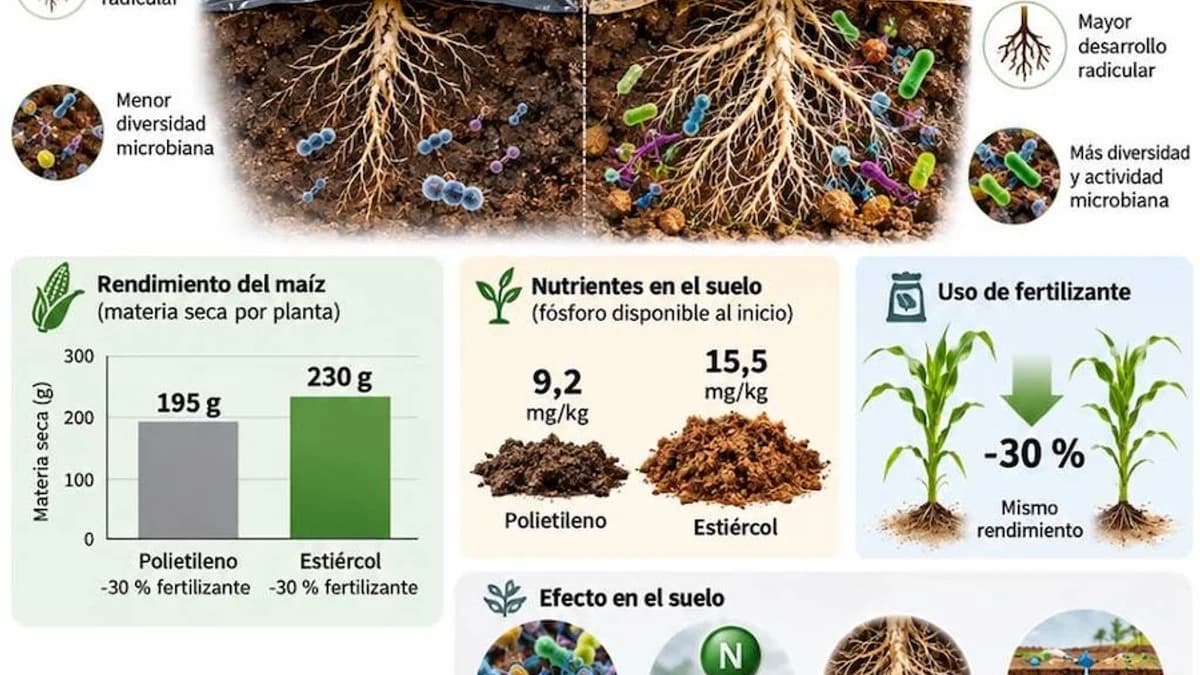
The agriculture industry has a trifecta of an environmental nightmare to solve: agricultural plastic waste, high fertilizer consumption, and livestock waste management. A team of researchers at China Agricultural University has a clever idea for solving all of those at once: a biodegradable agricultural film made from cow manure.
Unlike traditional polyethylene agricultural film, which functions primarily as a physical barrier and is associated with plastic waste accumulation in the agricultural environment, the new biodegradable film also serves to supply nutrients to the soil as it breaks down.
How Does the Manure Film Work?
As the film gets damp and begins to biodegrade, it emits organic matter and nutrients like nitrogen, phosphorus, and potassium into the surrounding soil.
The process also facilitates the proliferation of helpful soil bacteria. Certain types of soil bacteria, such as those involved in the nitrogen cycle, can fix nitrogen in the soil to help fertilize plants.
That’s a neat trick — instead of simply being a physical covering for the soil, the biodegradable film is also contributing to the fertility of the soil in which it is placed.
Has The Technology Been Tested?
The researchers tested the technology in the field by growing forage maize with the new film.
According to the study, the technology allowed researchers to maintain crop yields at the same level while reducing fertilizer use by 30% compared to the control group which used traditional plastic film. In a different test group that used 15% less fertilizer, the researchers found that the technology actually increased crop yield.
It seems, then, that using the cow manure film could reduce agricultural fertilizer use and simultaneously serve as an alternative to traditional polyethylene film.
But There’s a Catch
A life-cycle assessment of the technology found that the process of manufacturing the new film is quite energy and water-intensive. At the current production scale, it actually has a higher environmental impact than the conventional plastic film.
In short, the technology is not an immediate replacement for conventional polyethylene film from an environmental standpoint. The researchers need to find ways to make the production process less energy- and water-intensive.
Why Does It Matter That the Film is Made From Manure?
The agricultural sector is both a source of and sensitive to climate change. One of the best ways to reduce greenhouse gas emissions from the agricultural sector is to improve the efficiency of fertilizer application. The technology described in this study has the potential to do that.
Meanwhile, reducing the amount of plastic waste generated by the agricultural sector is also an environmental priority. The ability to replace plastic film with a biodegradable film made from a waste product would be enormously helpful in that regard.
In short, the technology could help achieve two key environmental goals at once: reducing greenhouse gas emissions and reducing plastic pollution.
From an agricultural production standpoint, the technology also has value in that it represents an innovative use of a waste product. The researchers at China Agricultural University are also suggesting that using the film could reduce overall fertilizer consumption in the agricultural sector.
The combination of those factors makes this particular piece of research quite interesting.
A Technology Still in Development
We should think of this technology as a concept, rather than as a commercially viable product at this stage in development.
Before this technology could replace traditional polyethylene agricultural film, researchers would need to improve upon the production process, estimate costs, and test the technology on a larger scale. This is a promising technology, but it has a long road ahead of it before it can be considered a real-world solution at an industrial level.
Other researchers around the globe are also working on similar concepts — the agricultural technology sector is currently witnessing a boom in manure-based products. In Chile, for example, researchers have already begun commercializing film made from manure, though their technology appears to involve a different application.
One of the most interesting takeaways from this research is that it represents a fundamentally different way of thinking about the problem of agricultural plastic waste. The researchers are also identifying a potentially valuable application for livestock waste, which is an agricultural problem on its own.
Source:
urlEurekAlert — China Agricultural University research reporthttps://www.eurekalert.org/news-releases/1145384